Bitcoin Hits $86,208: Who Is Missing? — October 5, 2026
Bitcoin leads a spot rebound below $87,000, but falling global market cap and incomplete ETF reporting leave the broader recovery unconfirmed.

Bitcoin rose 1.384% to 86,208.35 USDT while the aggregate crypto market capitalization fell 1.676% in a separate global snapshot. Four major Binance spot pairs were green, yet the wider market did not deliver the same reassuring message. If you are treating Monday’s rebound as a confirmed recovery, the missing ingredient is participation—and the next test sits just below 87,000 USDT.
What is Bitcoin doing on October 5?
Bitcoin is recovering inside its recent trading range, with a breakout still unconfirmed. Binance’s BTC/USDT snapshot showed a rolling 24-hour high of 86,999.11 and a low of 84,924.51. The last price was about 791 USDT below that high, leaving buyers with a nearby obstacle before any larger bullish claim becomes persuasive.
Research cutoff: October 5, 2026, 07:05:09 UTC. The spot ticker was retrieved at 07:00:54 UTC, CoinGecko global data at 07:00:55 UTC, and daily candles at 07:02:26 UTC. ETF and announcement pages were checked separately during the editorial review before this cutoff. These are distinct observations, not a synchronized consolidated feed.
The official Binance market overview provides reader-readable prices and pair information. Linked market pages show current data; this article preserves the research snapshot above. The market can move after publication, and USDT pair prices are not a claim about an identical executable USD price on every venue.
| Binance spot pair | Last price, USDT | Rolling 24h change | Rolling 24h quote volume |
|---|---|---|---|
| BTC/USDT | 86,208.35 | +1.384% | 996.81 million USDT |
| ETH/USDT | 2,724.80 | +1.061% | 408.31 million USDT |
| BNB/USDT | 793.74 | +0.657% | 106.17 million USDT |
| SOL/USDT | 121.45 | +0.372% | 179.87 million USDT |
Each return uses its pair’s rolling 24-hour window, ending near 07:00:54 UTC on October 5. Quote volume counts trading turnover on these Binance spot pairs. It does not measure net money entering crypto, nor does it include all exchanges, derivatives or ETF shares.
Bitcoin leads this small sample. Ethereum follows, while BNB and Solana post smaller gains. That is a useful observation about relative strength, but four large assets cannot stand in for thousands of tokens. A portfolio screen showing green can coexist with a weaker aggregate market.
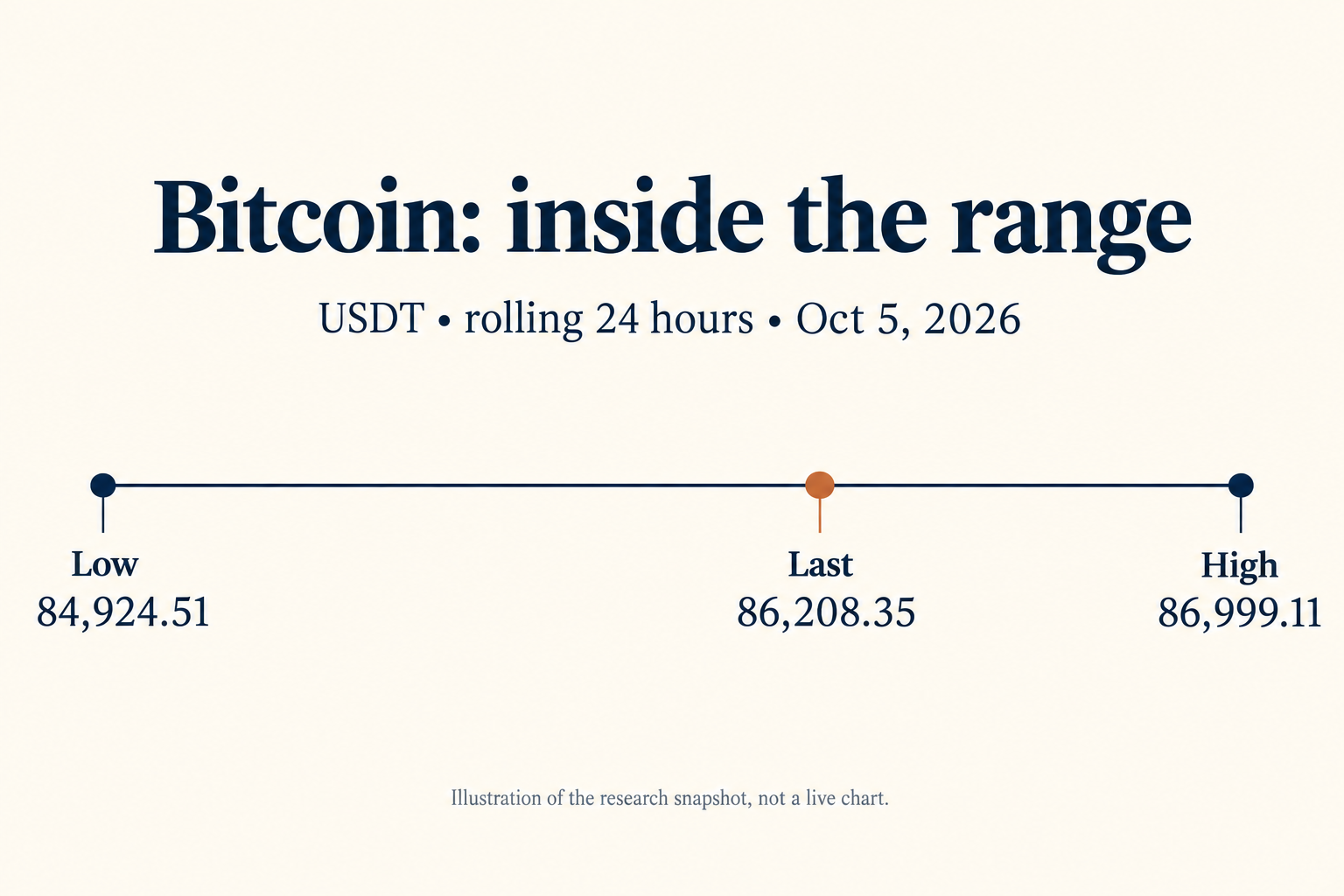
AI-generated snapshot illustration. The markers summarize observed range values; they do not depict a historical price path.
Why is a green Bitcoin price not enough?
The broader market snapshot does not confirm a uniform recovery. CoinGecko recorded approximately $2.916 trillion in total crypto market capitalization, down 1.676% over its reported 24-hour comparison. Its reported aggregate trading volume was $64.30 billion, with Bitcoin accounting for 59.26% of total market capitalization.
Readers can inspect the changing totals on CoinGecko’s official global market charts. These figures use CoinGecko’s coverage and valuation methodology; they are not computed from the four Binance pairs in the table.
That distinction matters. The two observations cannot tell us exactly which assets caused the aggregate decline. Differences in asset coverage, quote currencies, circulating-supply estimates and update timing can all affect the comparison. The defensible conclusion is narrower: Bitcoin’s positive venue-specific return is insufficient evidence that the entire market rose with it.
There is also a familiar accounting trap here. A lower market capitalization does not mean an equivalent amount of cash was withdrawn. Market cap reprices the estimated circulating supply at marginal prices. Volume measures gross trading activity. Neither number is a bank statement.
For a stronger recovery thesis, look for repeated evidence: Bitcoin holding reclaimed levels, more major assets participating, and aggregate capitalization stabilizing across comparable snapshots. Today’s data supports monitoring that possibility. It does not establish that it has already happened.
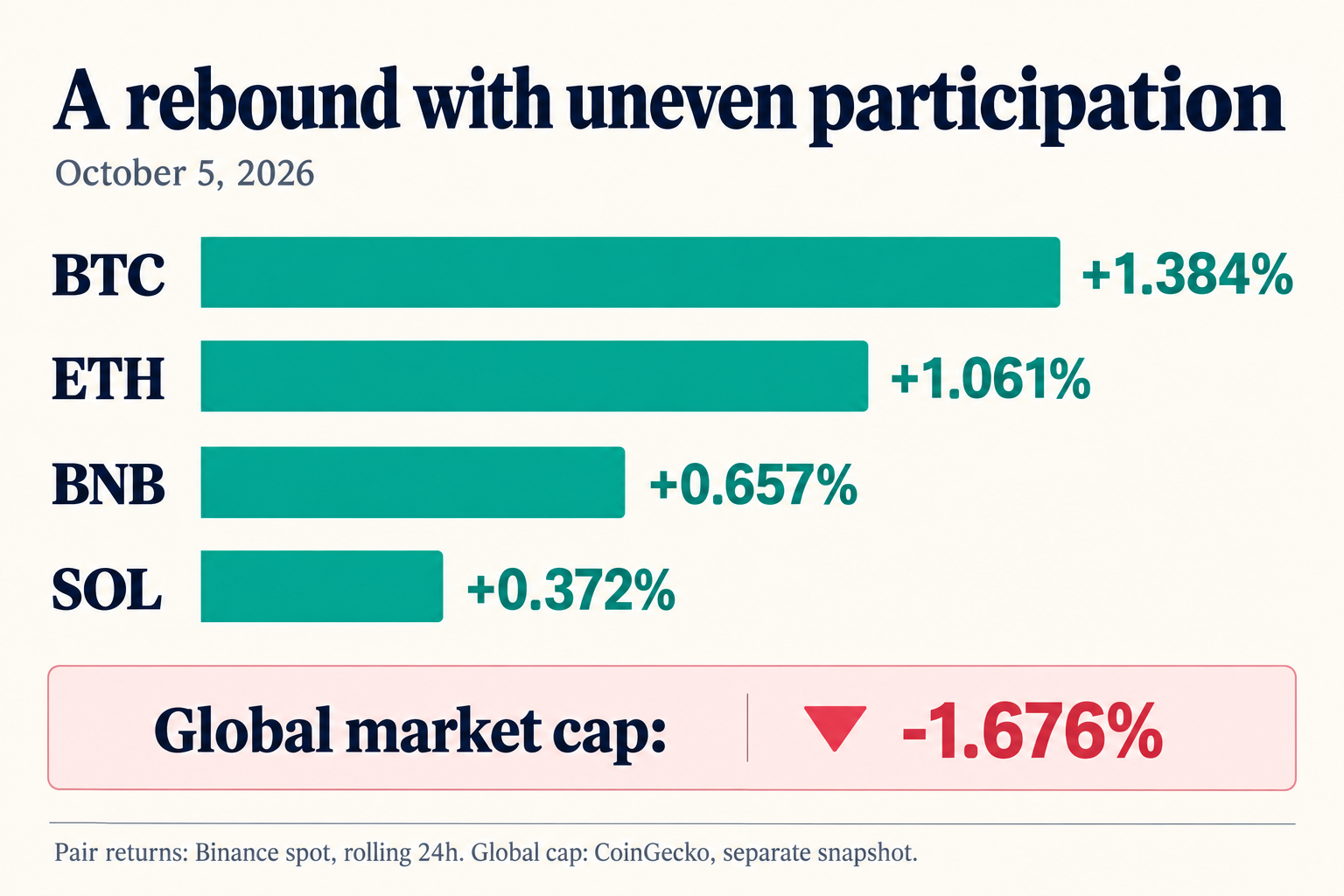
AI-generated comparison of separately sourced snapshots. Pair returns and global capitalization are different measures.
Which Bitcoin levels actually matter?
The immediate checkpoints are the observed 86,999.11 high and Friday’s 87,220 high, with the rolling low at 84,924.51 below. These are reference levels derived from retrieved exchange data, not guaranteed support or resistance.
Completed Binance UTC daily candles add context. October 2 reached 87,220 but closed at 84,518.01. October 4 reached 86,800 and closed at 86,530. Monday’s ticker was below that Sunday close despite showing a positive rolling 24-hour return. Different time windows can tell different stories without either being wrong.
| Reference | BTC/USDT level | Why watch it? |
|---|---|---|
| Rolling 24h high | 86,999.11 | Nearest observed upside boundary |
| October 2 daily high | 87,220.00 | Previous completed-session rejection area |
| October 4 daily close | 86,530.00 | Whether Monday can reclaim Sunday’s close |
| Rolling 24h low | 84,924.51 | Nearest observed downside boundary |
| October 4 daily low | 84,719.99 | Lower edge of Sunday’s completed candle |
The rolling range spans 2,074.60 USDT, about 2.44% of its low. The last price sits approximately 62% of the way from low to high. That is a recovery within the range, not a print above it.
A constructive scenario would involve sustained trading above the rolling high, followed by acceptance beyond 87,220 and broader participation. A brief wick above either level would offer weaker evidence than repeated closes and continued spot activity. No particular number of candles guarantees success.
The downside scenario is equally concrete: a return below 84,924.51 would erase the immediate range recovery, bringing Sunday’s lower boundary into focus. Those levels should frame reassessment, not automate conviction. Markets have an excellent record of making neat lines look untidy.
Has spot volume confirmed the move?
Participation improved on Sunday, but the completed daily turnover remained well below Friday’s. October 4 BTC/USDT quote volume was 683.67 million USDT, compared with 583.78 million on October 3 and 2.268 billion on October 2. Sunday turnover rose about 17.1% from Saturday while remaining about 69.9% below Friday.
That comparison uses completed UTC days, unlike the roughly 996.81 million USDT rolling ticker volume. Monday’s daily candle was still open at retrieval; its partial turnover should not be compared with a full day as though the sessions were equal.
A weekend-to-weekday volume comparison also needs context. Different participation schedules can depress weekend activity without signaling a structural demand collapse. Conversely, a stronger price on lighter turnover does not automatically demonstrate accumulating buyers. Volume tells you how much changed hands; it cannot identify motives on its own.
This article does not label the rebound whale accumulation. The research found whale-selling headlines, but no independently verified address-level dataset establishing a current net position change for the relevant cohort. Transfers can represent custody movements, exchange deposits or internal bookkeeping. A large wallet transaction is a clue, not a signed confession.
Why Friday’s ETF total needs a footnote
The latest ETF pages disagree because one table still has an unreported IBIT entry. At review, Farside Investors’ Bitcoin ETF table showed October 2’s displayed total as $31.7 million, with a dash for IBIT. A dash is missing data, not zero.
The TFTC Bitcoin ETF tracker instead reported $189.8 million for October 2, including $158.2 million for IBIT. Both pages showed $102.7 million for October 1. The arithmetic explains the different October starts: $134.4 million using Farside’s incomplete Friday subtotal, versus $292.5 million using TFTC’s reported Friday total.
Do not average those totals or silently promote the incomplete subtotal to a finalized figure. The differing IBIT coverage explains most of the gap; small rounding differences can also appear. This article attributes both readings rather than choosing a single definitive institutional-demand number.
October 5’s U.S. session had not occurred at the market cutoff. There was no completed Monday ETF flow to pair with Monday morning’s Bitcoin price. ETF flows also measure net creations and redemptions, not total secondary-market share turnover. Even a finalized positive figure would describe one demand channel, not every buyer in crypto.
If you choose to trade this range
The useful decision comes before the order: define what evidence would invalidate your thesis, and size the exposure so that a failed range break remains manageable. The snapshot offers reference prices; it does not offer an instruction to buy.
If Binance is available in your jurisdiction and you decide to open an account, register on Binance with RATE20 →. The link pre-applies RATE20; review the displayed referral benefit, product eligibility and fee terms before completing registration. Any advertised 20% benefit depends on the terms shown for your account.
For the site’s walkthrough, see Get 20% off with code RATE20. This is a referral link, and SmallDrift may receive compensation. Fees, spreads and slippage still matter even when a rebate is available.
Keep exchange notices separate from market catalysts
The official Binance stock-service upgrade notice scheduled a partner-broker upgrade for October 3, 11:00–14:00 UTC. It concerned stock orders, rather than a stated suspension of BTC/USDT spot trading.
The scheduled window was already past at this article’s cutoff. The notice said services would resume after completion, but a planned timetable is not independent confirmation of completion. There is no evidence in the retrieved material connecting this maintenance notice to Monday’s Bitcoin return. Operational announcements belong in a trader’s checklist; they do not become price catalysts merely because they share an exchange’s name.
FAQ
What is Bitcoin’s price on October 5, 2026?
The research snapshot recorded Binance BTC/USDT at 86,208.35 USDT, up 1.384% over its rolling 24-hour window. It was retrieved at 07:00:54 UTC. The linked market pages show current prices, which can differ from this historical observation.
Has Bitcoin broken above $87,000?
Not in the retrieved rolling ticker: its high was 86,999.11 USDT. Friday’s completed daily high was 87,220. A move beyond these levels would require fresh data and should be assessed alongside persistence and participation.
How much did Bitcoin ETFs receive on October 2?
Farside displayed an incomplete $31.7 million subtotal; TFTC reported $189.8 million including IBIT. The missing IBIT entry prevents treating Farside’s displayed number as a complete final total. Neither reading supplies a completed October 5 flow.
Monday’s practical test is whether Bitcoin can turn a stronger spot price into a durable move beyond the recent highs. Until breadth and comparable volume observations improve, confidence should grow more slowly than the headline price.
Create your Binance account with RATE20 →. Review the referral details and applicable terms at signup.
This article is for informational purposes only and does not constitute financial advice. Always do your own research before making investment decisions.
Get 20% Off Binance Trading Fees with RATE20
New to Binance? Open the official signup page with RATE20 already applied for a 20% trading-fee discount. You do not need to copy or type the code. Review the referral details before completing registration.

- Referral code: RATE20, pre-applied by this link
- Fee discount: 20%, shown on the Binance signup screen
- Additional rewards: Check Binance for current promotions and regional availability
Be wary of unofficial referral offers promising benefits they cannot show. The Binance signup screen lets you check the code and fee discount directly.
Compare Binance fees and available discounts →
SmallDrift may earn a commission when you sign up through this link. Trading involves risk, including loss of capital.
Related Articles



Explore Related Guides
Daily Crypto Market News
Follow Bitcoin price moves, major altcoins, and the events shaping the market.
Bitcoin ETF Flows Guide
Understand ETF inflows and outflows, and how to read them alongside price action.
Binance Fee Calculator
Learn how to estimate trading costs with referral and BNB discounts.
Verified Binance Referral Guide
See how RATE20 is applied and what to check on the Binance signup screen.