Binance Spot vs Futures: Key Differences Explained
Understand the differences between spot and futures trading on Binance, including fees, leverage, and risk.
What Is Spot Trading?
Spot trading means buying or selling cryptocurrency at the current market price for immediate delivery. When you buy 1 BTC on the spot market, you own 1 BTC — it's deposited into your spot wallet and you can withdraw it, transfer it, or hold it indefinitely.
Spot trading is the most straightforward form of trading. You can only profit when prices go up (buy low, sell high). Your maximum loss is limited to your investment — if you buy $1,000 of BTC and it drops 50%, you lose $500. It cannot go below zero.
On Binance, spot trading supports hundreds of trading pairs. The most liquid pairs (BTC/USDT, ETH/USDT) have extremely tight spreads and deep order books. You can place market orders for instant execution, or limit orders to specify your desired price.
What Is Futures Trading?
Futures trading involves trading contracts that derive their value from an underlying cryptocurrency. You don't own the actual asset — instead, you hold a position that profits or loses based on price movement.
Binance offers two types of futures: Perpetual contracts (no expiry date, most popular) and Quarterly contracts (fixed expiry dates). USDT-margined contracts are settled in USDT, while Coin-margined contracts are settled in the underlying cryptocurrency.
The key features of futures trading: You can go long (profit from price increases) or short (profit from price decreases). You can use leverage from 1x to 125x, meaning you can control a larger position with less capital. Your position has a liquidation price — if the market reaches this level, your position is automatically closed.
Futures allow you to profit in both rising and falling markets, hedge existing spot holdings, and amplify returns (and losses) through leverage.
Understanding Leverage
Leverage lets you open a position larger than your capital. With 10x leverage, $1,000 in margin controls a $10,000 position. This amplifies both profits and losses by the leverage factor.
Example with 10x leverage on a $10,000 BTC long position ($1,000 margin): If BTC rises 5%, your profit is $500 (50% return on $1,000 margin). If BTC falls 5%, your loss is $500 (50% of margin). If BTC falls 10%, your loss is $1,000 (100% — full liquidation).
Binance offers up to 125x leverage on BTC/USDT, but this doesn't mean you should use it. At 125x, a mere 0.8% price move against you triggers liquidation. Professional traders typically use 2-5x leverage, and rarely exceed 10x.
Binance allows you to adjust leverage per position. You can start with 3x and increase or decrease it as market conditions change. New futures accounts are limited to 20x leverage by default — this is a deliberate safety measure.
Cross margin vs Isolated margin: Cross margin uses your entire futures wallet as collateral, reducing liquidation risk but exposing all funds. Isolated margin limits each position's collateral to the assigned margin, protecting other positions but increasing liquidation risk for that specific trade.
Fee Comparison: Spot vs Futures
Futures fees are lower than spot fees, which incentivizes trading on the futures market:
Spot: 0.10% maker and taker (0.06% with referral + BNB). Futures: 0.02% maker, 0.05% taker (0.016% / 0.04% with referral).
However, futures have an additional cost: funding rates. Funding rates are payments exchanged between long and short position holders every 8 hours (00:00, 08:00, 16:00 UTC). The rate varies based on market sentiment.
When the funding rate is positive (common during bullish markets), longs pay shorts. When negative, shorts pay longs. Rates typically range from -0.01% to +0.03% per 8-hour period, but can spike to 0.1% or higher during extreme market conditions.
For short-term trades (minutes to hours), funding rates are negligible. For positions held for days or weeks, accumulated funding can significantly impact profitability. A 0.03% funding rate paid three times daily equals 0.09% per day or 2.7% per month — more than enough to erode profits.
Ready to get started?
Liquidation Explained
Liquidation occurs when the market price reaches your position's liquidation price, and your margin is no longer sufficient to maintain the position. Binance's liquidation engine closes your position to prevent your losses from exceeding your margin.
Liquidation price depends on your leverage, entry price, and margin mode. Simplified formula: For a long position with isolated margin, liquidation price ≈ Entry price × (1 - 1/leverage + maintenance margin rate). At 10x leverage with ~0.5% maintenance margin, a long entered at $70,000 liquidates at approximately $63,350 (a 9.5% drop).
Binance uses a tiered liquidation system. Before full liquidation, the system attempts partial liquidation by reducing position size and leverage. This gives your position a better chance of survival during temporary wicks.
To avoid liquidation: use lower leverage (3-5x maximum), set stop-loss orders before liquidation price, maintain extra margin in your account (cross margin), and never risk more than 1-2% of your total capital on a single trade.
Insurance Fund: Binance maintains a futures insurance fund to cover losses when a trader's position is liquidated at a price worse than their bankruptcy price. This protects other traders from socialized losses.
When to Use Spot Trading
Spot trading is appropriate for: Long-term holding (investing in BTC, ETH for months/years). Dollar-cost averaging (regular purchases regardless of price). Beginners who are still learning market dynamics. Anyone who wants to actually own and potentially use/transfer their crypto.
Advantages: No liquidation risk. No funding rate costs. You own the actual asset. Simpler to understand and execute. Can transfer, stake, or use in DeFi.
Spot is the foundation of crypto trading. Even experienced futures traders typically hold a significant portion of their portfolio in spot positions for long-term appreciation.
When to Use Futures Trading
Futures trading is appropriate for: Hedging existing spot holdings against downside. Short-selling during bear markets. Active trading with defined risk parameters. Capital-efficient trading (doing more with less).
Hedging example: You hold 1 BTC worth $70,000 and worry about a short-term drop. You open a 1 BTC short futures position. If BTC drops to $60,000, your spot portfolio loses $10,000 but your futures position gains $10,000 — net neutral. You keep your BTC while being protected.
Short-selling: In spot, you can only profit when prices rise. Futures let you profit from price declines by going short. This is valuable during bear markets or for trading range-bound markets in both directions.
Futures are NOT appropriate for beginners, anyone who doesn't understand liquidation mechanics, or traders who can't manage risk discipline. The leverage amplification works both ways — the same tool that can 10x your profits can 10x your losses.
How to Enable Futures on Binance
To access futures trading on Binance, you must: Have a verified Binance account (KYC completed). Pass a short quiz about futures trading concepts. This quiz covers leverage, liquidation, margin, and risk management basics.
After passing the quiz, you can transfer funds from your spot wallet to your futures wallet. Note: spot and futures wallets are separate on Binance. You can transfer between them instantly and for free.
Binance limits new futures users to 20x maximum leverage for the first 60 days. This is a protective measure. After 60 days, you can access higher leverage levels.
Important settings to configure: Set your default leverage to 3-5x (not the maximum). Choose between cross and isolated margin based on your strategy. Enable price alerts and stop-loss reminders.
Common Mistakes to Avoid
Using maximum leverage: 125x leverage means liquidation at 0.8% adverse movement. Even professional traders rarely exceed 10x. Start with 2-3x and increase only as you gain experience.
No stop-loss: Every futures position should have a stop-loss order. Without one, a sudden crash can liquidate your entire position before you can react. Set your stop-loss before entering the trade, not after.
Ignoring funding rates: Holding positions through multiple funding rate intervals can quietly drain your profits. Check the current funding rate and factor it into your trade plan.
Overtrading: More trades = more fees = more opportunities for mistakes. Quality over quantity. Wait for high-conviction setups rather than trading every small movement.
Not tracking P&L: Keep a trading journal. Record your entry, exit, leverage, fees, and funding costs for every trade. Without tracking, you can't identify what's working and what isn't.
Trading with money you can't afford to lose: This is the most important rule. Futures with leverage can lose your entire position in minutes. Only trade with capital that wouldn't impact your life if lost completely.
Get 20% Off Binance Trading Fees with RATE20
New to Binance? Open the official signup page with RATE20 already applied for a 20% trading-fee discount. You do not need to copy or type the code. Review the referral details before completing registration.
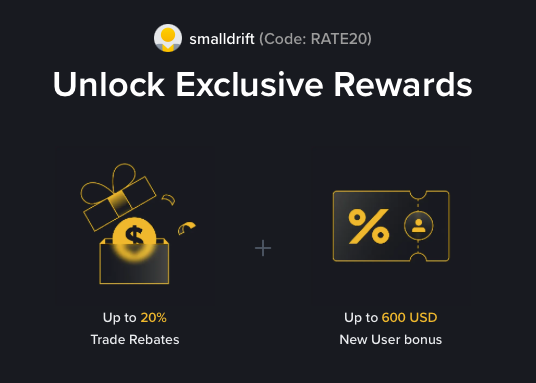
- Referral code: RATE20, pre-applied by this link
- Fee discount: 20%, shown on the Binance signup screen
- Additional rewards: Check Binance for current promotions and regional availability
Be wary of unofficial referral offers promising benefits they cannot show. The Binance signup screen lets you check the code and fee discount directly.
Compare Binance fees and available discounts →
SmallDrift may earn a commission when you sign up through this link. Trading involves risk, including loss of capital.