Best Crypto Exchange for Beginners in 2026
A beginner's guide to choosing the right cryptocurrency exchange. Comparing fees, ease of use, and security.
What to Look for in Your First Exchange
Choosing your first crypto exchange is one of the most important decisions in your crypto journey. The wrong choice can cost you hundreds in unnecessary fees, expose you to security risks, or limit your options as you grow.
Key factors to evaluate: Trading fees (the #1 ongoing cost). Security features (2FA, insurance funds, cold storage). Ease of use (interface complexity, mobile app quality). Coin selection (how many cryptocurrencies are available). Fiat on-ramps (can you deposit with bank transfer, card, etc.). Customer support (responsiveness and availability). Regulatory status (licenses, insurance, compliance).
A common mistake is choosing based on ease of use alone. Coinbase is often recommended for beginners because of its simple interface, but its fees are 5-7x higher than competitors. Over time, those extra fees add up to thousands of dollars. A slightly steeper learning curve is worth the savings.
#1 Pick: Binance — Lowest Fees, Most Features
Binance is the world's largest crypto exchange by trading volume, serving 180+ countries. It consistently ranks #1 for fees, liquidity, and feature set.
Fees: 0.10% base (0.06% with referral code RATE20 + BNB discount). This is the lowest fee structure available to retail traders. Coins: 350+ cryptocurrencies, 600+ trading pairs. New listings added regularly through Launchpad. Liquidity: Highest 24h trading volume globally, meaning minimal slippage on every trade.
For beginners specifically: Binance Lite mode simplifies the mobile app to a basic buy/sell interface, similar to Coinbase. You can start with Lite mode and switch to Pro when ready, without changing platforms or losing your fee discount.
Additional features: Binance Earn (staking and savings), copy trading, grid bots, P2P marketplace, and Binance Academy (free educational content). No other exchange matches this breadth.
Drawbacks: The full interface can be overwhelming initially. Not available in the US (US users must use Binance.US). KYC is required for all functions.
#2 Pick: Coinbase — Simplest Interface, US-Regulated
Coinbase is the most well-known exchange in the United States, publicly traded on NASDAQ. Its strength is simplicity — the interface is clean and intuitive, making it easy for complete beginners to buy their first crypto.
Fees: 0.40% maker, 0.60% taker on Advanced Trade. Simple buy/sell can cost up to 1.49% + spread. No referral discounts available. Coins: 250+ assets, focusing on established projects. Security: US-regulated, publicly traded, insured against breaches.
Coinbase is the best choice if: You're in the US and want maximum regulatory protection. You only plan to buy and hold major coins (BTC, ETH). Simplicity is your absolute top priority and you're willing to pay 5-7x more in fees.
Coinbase is NOT the best choice if: You trade actively (fees will eat your profits). You want futures, margin, or advanced features. You want the widest selection of altcoins. You're outside the US (better options available).
#3 Pick: OKX — Strong All-Rounder
OKX is the third-largest exchange globally and offers an excellent balance of fees, features, and user experience. Its built-in Web3 wallet is one of the best in the industry.
Fees: 0.08% maker, 0.10% taker (competitive with Binance). Up to 20% referral discount available. Coins: 300+ assets with good altcoin coverage. Features: Spot, futures, options, DeFi aggregator, Web3 wallet, copy trading.
OKX stands out for its Web3 integration — the OKX Wallet supports 80+ blockchains and includes a built-in DEX aggregator, NFT marketplace, and DApp browser. For users interested in both centralized trading and DeFi, OKX offers the most seamless experience.
#4 Pick: Bybit — Best for Copy Trading
Bybit has grown rapidly and is known for its clean interface and strong copy trading feature. It's a good choice for beginners who want to follow experienced traders.
Fees: 0.10% maker/taker on spot (similar to Binance). Up to 20% referral discount. Coins: 500+ assets. Features: Copy trading, trading bots, Bybit Earn, Launchpad.
Bybit's copy trading allows you to automatically replicate the trades of successful traders. You can browse trader profiles, see their historical performance, and allocate funds to copy their strategies. This is a lower-risk way to learn while potentially earning.
Drawback: Limited fiat deposit options in some regions. Futures-focused platform that may have less spot liquidity than Binance for some pairs.
Ready to get started?
#5 Pick: Kraken — Best Security Track Record
Kraken has never been hacked in its 10+ years of operation — the best security record in the industry. It's well-regulated and offers competitive features.
Fees: 0.16% maker, 0.26% taker (higher than Binance/OKX). No referral discounts available. Coins: 200+ assets. Features: Spot, futures (up to 50x), staking, NFTs.
Kraken is strong for European users, with excellent SEPA deposit support (free EUR deposits). Its security practices are industry-leading, including regular proof-of-reserves audits.
Drawback: Higher fees than Binance with no way to reduce them through referrals or token discounts. Fewer features and trading pairs. Less competitive for active traders.
Security Checklist for Beginners
Regardless of which exchange you choose, complete this security setup immediately:
1. Enable 2FA (Google Authenticator preferred over SMS). Save the backup recovery key offline. 2. Set a unique, strong password not used anywhere else. Consider a password manager. 3. Enable withdrawal address whitelisting (restricts where funds can be sent). 4. Set up anti-phishing code (Binance) to identify legitimate emails. 5. Bookmark the official exchange URL — never click links from emails or social media. 6. Enable login notifications to detect unauthorized access. 7. Review authorized devices weekly and remove any you don't recognize.
Common scams targeting beginners: Phishing emails that mimic exchange login pages. Social media accounts impersonating exchange support staff. 'Too good to be true' investment schemes asking you to send crypto. Fake exchange apps in unofficial app stores. Never share your 2FA codes, password, or seed phrases with anyone.
How Much Money to Start With
You can start trading crypto with as little as $10-50 on most exchanges. Binance's minimum order is typically around $10 for spot trading.
Recommendation: Start with an amount you're completely comfortable losing — $100-500 is reasonable for most beginners. Use this initial capital to learn the platform, understand how orders work, and experience market volatility emotionally before committing larger amounts.
Don't invest your emergency fund, rent money, or borrowed money. Cryptocurrency is volatile — 20-30% drops within a week are normal, and 50%+ crashes happen every few years. Only invest money that wouldn't impact your daily life if it went to zero.
A good starting strategy: Buy Bitcoin and/or Ethereum with a fixed amount each week or month (dollar-cost averaging). This removes the stress of trying to time the market and builds a position over time at an average price.
Common Beginner Mistakes
FOMO buying: Seeing a coin up 50% and buying at the peak. By the time something is in the news, the easy gains are often over. Stick to your plan and avoid chasing pumps.
No exit strategy: Decide before buying when you'll take profits or cut losses. Without a plan, emotions drive decisions — and emotional trading almost always loses money.
Using leverage too early: Futures and leverage are for experienced traders. Master spot trading first. Many beginners have lost their entire capital within days of trying leveraged trading.
Overdiversifying: Buying 30 different coins with $500 means tiny positions that can't meaningfully grow. Focus on 3-5 well-researched assets.
Ignoring fees: Trading frequently on a high-fee exchange destroys returns. A trader paying 0.50% per trade who makes 100 trades loses 50% of their capital to fees alone, regardless of price movement.
Not doing research: Never buy a coin just because someone on social media recommended it. Understand what the project does, its market cap, trading volume, and team before investing.
Quick-Start Guide: Your First 30 Minutes
Here's exactly what to do in your first session:
1. Sign up through a referral link to lock in fee discounts (Binance code: RATE20 for 20% off). 2. Complete email/phone verification. 3. Complete KYC (have your ID ready — takes 5-10 minutes). 4. Enable Google Authenticator 2FA. 5. Deposit funds (P2P or bank transfer for lowest fees). 6. Buy a small amount of BTC or ETH using a limit order. 7. If using Binance, buy a small amount of BNB and enable 'Use BNB for Fees' for additional 25% discount.
Congratulations — you're now set up with the lowest possible fees and strong security. Take time to explore the platform, read educational resources, and develop your investment strategy before committing larger amounts.
Get 20% Off Binance Trading Fees with RATE20
New to Binance? Open the official signup page with RATE20 already applied for a 20% trading-fee discount. You do not need to copy or type the code. Review the referral details before completing registration.
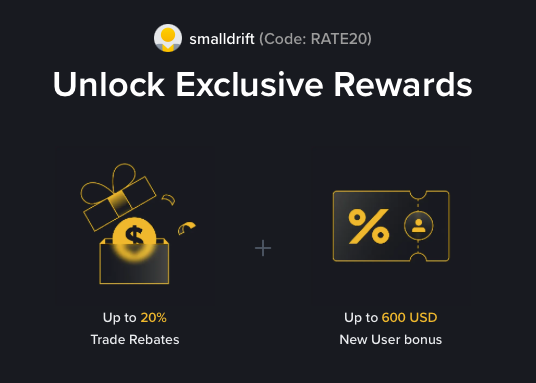
- Referral code: RATE20, pre-applied by this link
- Fee discount: 20%, shown on the Binance signup screen
- Additional rewards: Check Binance for current promotions and regional availability
Be wary of unofficial referral offers promising benefits they cannot show. The Binance signup screen lets you check the code and fee discount directly.
Compare Binance fees and available discounts →
SmallDrift may earn a commission when you sign up through this link. Trading involves risk, including loss of capital.