Bitcoin's $84K Test Before CPI — October 14, 2026
Bitcoin holds near $83,392 before CPI. ETF inflows rebound, but five-session outflows and weaker altcoins leave the $84K recovery unconfirmed.

Bitcoin is less than 1% below its rolling high, yet its recovery still has a $84,000 problem. Binance BTC/USDT traded at 83,391.66 USDT in this morning’s snapshot, while Ether and Solana were losing ground faster. With U.S. inflation data still ahead, the question is whether buyers can sustain a move above resistance after the number arrives.
Tuesday’s return of ETF inflows helps. It does not settle the argument. A positive session can coexist with a negative run of sessions, and a recovering Bitcoin can coexist with a market that remains selective. Those distinctions matter more than a green candle on a phone screen.
Research cutoff: October 14, 2026, 07:02:07 UTC. Exchange snapshots were retrieved around 07:01 UTC. Prices below are Binance spot pairs against USDT; changes, highs, lows and turnover cover each pair’s rolling 24-hour window ending around 07:01 UTC, not a completed UTC calendar day. The linked market pages show current data and may differ from this historical snapshot. The September CPI release had not occurred at the cutoff.
What is Bitcoin’s price today?
Bitcoin’s Binance BTC/USDT snapshot was 83,391.66 USDT, down 0.464% over the rolling 24 hours. Its window ranged from 82,972.74 to 84,168.00 USDT. That is a relatively narrow immediate range ahead of a scheduled macro event, rather than proof that volatility has disappeared.
The official Binance markets overview provides a reader-readable view of the traded assets. USDT quotes are close to dollar prices under normal conditions, but they are not identical to a consolidated BTC/USD benchmark across exchanges.
| Binance spot pair | Last price, USDT | Rolling 24h change | Rolling low, USDT | Rolling high, USDT | Quote turnover, USDT |
|---|---|---|---|---|---|
| BTC/USDT | 83,391.66 | -0.464% | 82,972.74 | 84,168.00 | 1.091 billion |
| ETH/USDT | 2,504.00 | -1.213% | 2,489.00 | 2,538.44 | 434.55 million |
| SOL/USDT | 107.09 | -1.381% | 105.63 | 109.07 | 218.29 million |
| BNB/USDT | 742.30 | -0.491% | 736.87 | 747.53 | 48.77 million |
These figures describe one exchange’s spot trading. Quote turnover is the gross USDT value traded in each pair, not net capital entering the asset. Every transaction has a buyer and seller; a large turnover number alone does not reveal which side is gaining conviction.
The immediate pattern is selective weakness. Ether underperformed Bitcoin by about 0.75 percentage points; Solana lagged by about 0.92 points. BNB’s decline was closer to Bitcoin’s. Four pairs cannot establish the condition of every altcoin, but they do challenge the idea that the rebound is already a broad risk-on move.
ETF buyers returned. The recent balance is still negative
Farside’s US spot Bitcoin ETF table recorded $175.7 million of net inflows on October 13: FBTC added $103.1 million, IBIT $65.9 million and MSBT $6.7 million.
| US trading session | Net Bitcoin ETF flow |
|---|---|
| October 7 | -$484.9 million |
| October 8 | -$244.1 million |
| October 9 | +$21.1 million |
| October 12 | -$65.4 million |
| October 13 | +$175.7 million |
| Five-session sum, calculated | -$597.6 million |
Tuesday’s inflow recovered roughly 24% of the combined October 7–8 withdrawals. These daily figures may be revised; the October 14 session was not available at the cutoff. Fund flows describe creations and redemptions, rather than total exchange trading volume in ETF shares.
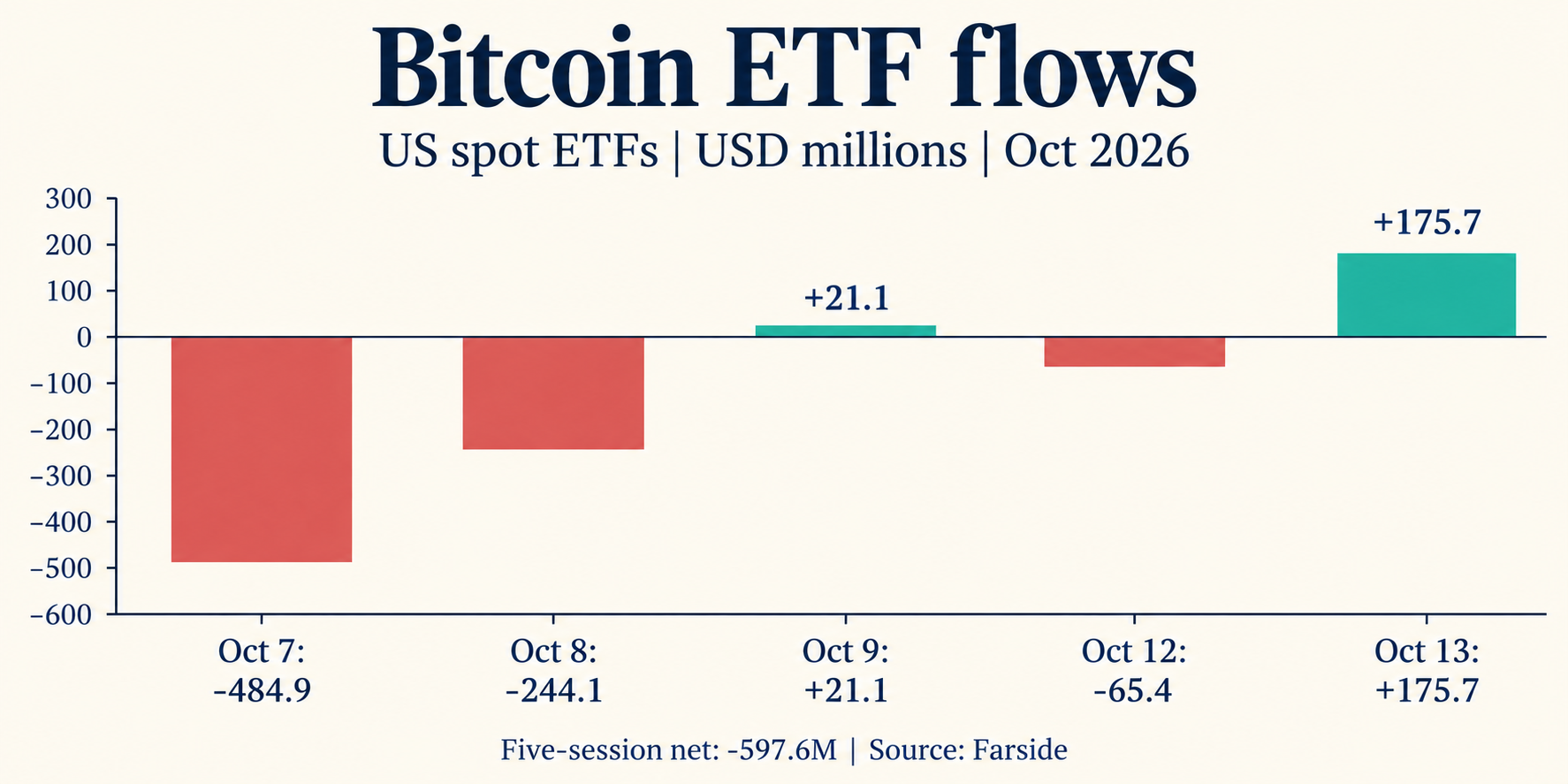
The useful distinction is between a change in direction and a change in the accumulated balance. Imagine a reservoir after several days of drainage: one day of inflow improves the situation without restoring its former level. Markets respond to both the latest impulse and the history that preceded it.
That also explains why a positive flow headline need not generate an immediate price breakout. Other holders can sell, derivatives traders can reduce exposure, and a pending economic release can discourage fresh commitments. ETF demand is one component of the market, with a reporting schedule of its own.
Why today’s CPI release matters
September CPI is scheduled for October 14 at 12:30 UTC, equivalent to 8:30 a.m. Eastern daylight time. The Bureau of Labor Statistics calendar confirms the release date and Eastern time. No September CPI outcome is reported here because publication follows the research cutoff.
Inflation can alter expectations for monetary policy and the return available on cash and bonds. Those expectations can change the willingness to hold volatile assets. Bitcoin does not have an automatic inverse relationship with inflation, however, and the same headline can produce different reactions depending on what traders already expected.
A cooler reading could improve sentiment, especially if underlying details also ease. A hotter reading could make traders reconsider the interest-rate outlook. Both statements are conditional scenarios. This research did not establish a reliable consensus forecast, so calling any specific number a surprise in advance would be premature.
Watch the sequence rather than one isolated print. The initial price reaction shows how orders hit the market; the subsequent reaction shows whether that move attracted sustained participation. A headline rally that fades quickly carries a different message from one that holds through a retest.
Also distinguish the release itself from commentary about it. An analyst may focus on the annual headline rate, while another emphasizes monthly core inflation or a particular component. Read the actual figures before accepting the loudest interpretation. The fastest explanation is not always the most useful one.
Which Bitcoin levels matter around $84,000?
The closest observable reference points are the rolling low near $82,973 and rolling high at $84,168. The round $84,000 area sits between the snapshot price and that high. These are reference levels derived from this snapshot, not a validated order-book wall or a promise that either will hold.
| BTC/USDT reference | Distance from 83,391.66 | What to observe |
|---|---|---|
| 82,972.74 rolling low | -0.50% | Whether selling below the recent range is sustained |
| 83,391.66 snapshot | 0.00% | Starting point for this article’s comparison |
| 84,000 round level | +0.73% | Whether price can remain above the psychological threshold |
| 84,168.00 rolling high | +0.93% | Whether a move clears the observed range and survives a retest |
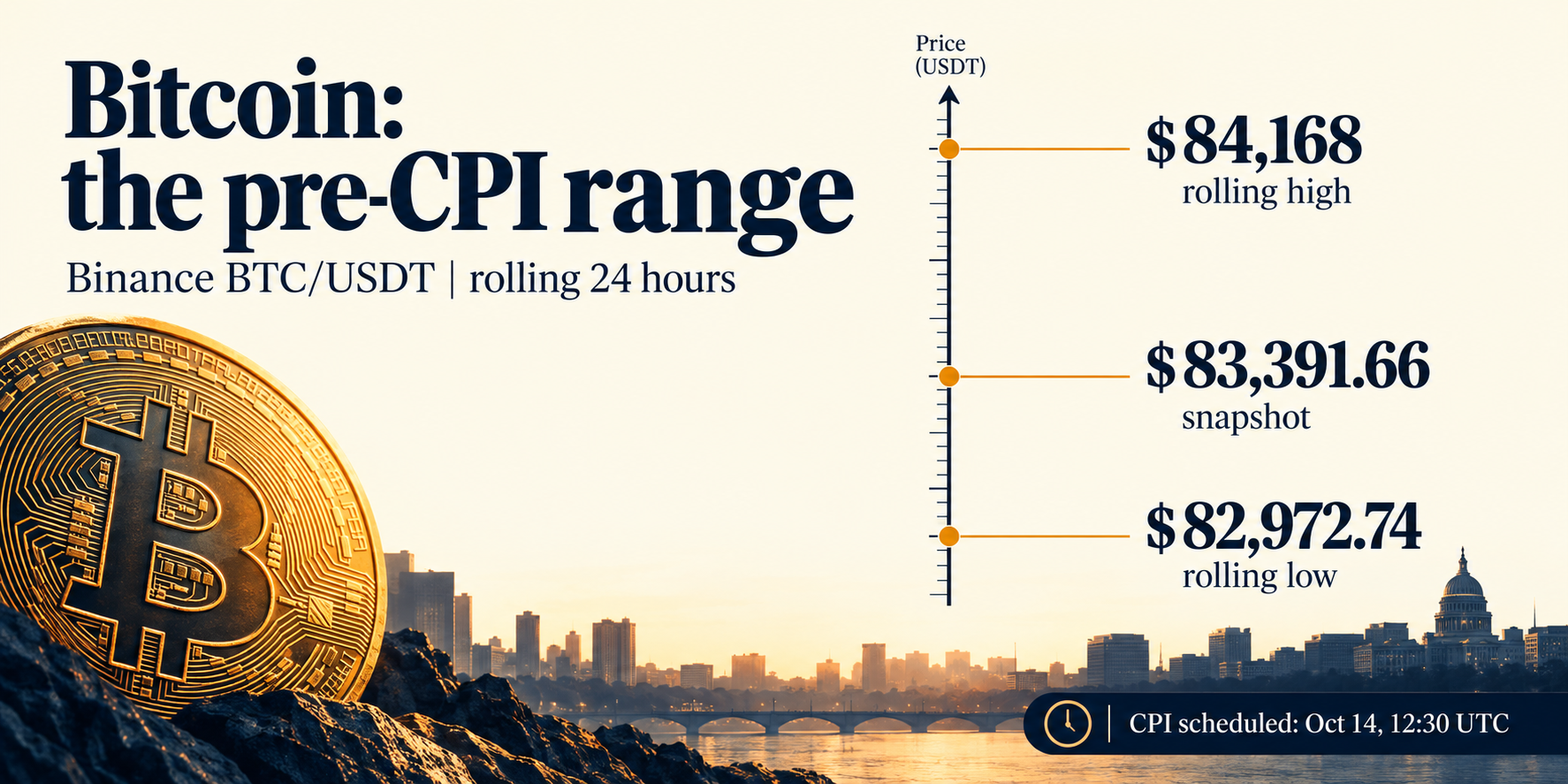
The rolling high-to-low span was about 1.43% of the snapshot price. An economic release can push trading beyond that range, making yesterday’s apparently tidy boundaries less useful. Technical levels should update with evidence rather than become a permanent attachment.
A constructive scenario would combine a sustained move above the rolling high with improved participation in Ether and Solana. A weaker scenario would involve a failed move through $84,000 followed by sustained trading below the rolling low. A third possibility is continued range trading, with neither side establishing control.
None of those scenarios requires a confident forecast. They require a clear observation that would strengthen or weaken a view. There is a practical difference between saying “Bitcoin must rise” and saying “the recovery case improves if buyers defend a breakout.” The latter can be evaluated after the event.
Trade execution deserves attention before the headline
For readers who independently decide to open an eligible Binance account, prepare account verification and order settings before a volatile release. Understanding an order type is more useful than discovering its limitations while prices are moving.
Register on Binance with referral code RATE20 →
The link pre-applies RATE20. Check the referral benefit and eligibility displayed during registration; fee terms depend on the account, product and region. This is a referral link, and SmallDrift may receive a commission. Our guide explains how to get 20% off with code RATE20, subject to the terms shown by Binance.
A limit order controls the acceptable execution price but may remain unfilled. A market order prioritizes execution while accepting the prices available. During a fast move, the difference between the chart’s last price and your actual fill can matter more than a small fee discount.
Whale accumulation is context, not a countdown
CryptoQuant’s October 13 report, supported by CoinRabbit, put whale holdings excluding exchange and mining-pool addresses at 3.03 million BTC, the highest since November 21, 2025. It described accelerating monthly accumulation.
That is the report’s historical on-chain assessment, not a freshly retrieved whale-balance API measurement. It supports a medium-term demand argument; it does not identify the next hourly price move. Address classifications are estimates, and greater holdings do not prove every transfer was an open-market purchase.
The distinction matters because time horizons can disagree without either being meaningless. A holder accumulating over weeks can tolerate a decline that would overwhelm a highly leveraged intraday position. Borrowing against coins also introduces different risks from buying spot with unborrowed cash.
Treat an accumulation report as background for assessing demand. Then use price behavior and your own holding period to judge whether that background is relevant to the decision in front of you. A whale headline does not come with your position size attached.
Binance’s Pool closure is a separate operational story
Binance’s official Pool closure notice schedules discontinuation for November 10, 2026, at 07:00 UTC. Affected services include mining-pool operations, Pool Savings, Cloud Mining and the Transaction Accelerator. Miners should arrange an alternative pool, and affected users should review positions and retain records before the relevant deadlines.
This concerns those services. It does not establish that Binance spot trading is closing, nor does it by itself explain today’s Bitcoin price. Operational notices can matter greatly to affected users while having limited relevance to the immediate market thesis.
For market readers, the practical lesson is to separate product availability from asset exposure. Owning Bitcoin, trading BTC/USDT and operating mining equipment through a pool are different activities. A change affecting one does not automatically answer questions about the others.
What should readers monitor after the cutoff?
Use a short sequence of checks instead of collecting every available indicator:
- The published CPI figures: compare the actual report with a clearly identified expectation, rather than a vague claim that inflation was “good” or “bad.”
- The BTC/USDT range: check whether price stays beyond a boundary after the first reaction.
- Participation: see whether the weakness in ETH/USDT and SOL/USDT eases alongside Bitcoin.
- The next completed ETF session: wait for reported data rather than treating an unfinished day as a confirmed flow.
These checks serve different purposes. Inflation addresses the catalyst, the range addresses price response, participation addresses breadth, and completed flows address one channel of demand. Agreement between them would make a market interpretation more persuasive; disagreement would call for more patience.
If you choose to create an account, review the available products and displayed terms first.
Create a Binance account with RATE20 pre-applied →
Referral code: RATE20. Confirm any fee benefit during signup. Smaller costs help execution, but they do not determine whether the market view is correct.
Frequently asked questions
Why is Bitcoin still below $84,000 despite ETF inflows?
A positive ETF session does not guarantee enough demand to overcome selling elsewhere. Tuesday improved the flow picture, while the calculated five-session balance remained negative. Pending CPI also leaves the immediate price response uncertain.
Has the October 14 CPI report already been released?
It had not been released at the 07:02:07 UTC research cutoff. The scheduled publication time is 12:30 UTC. Readers visiting later should check the published report and current prices rather than treat this pre-release snapshot as a post-release assessment.
Is $82,973 guaranteed Bitcoin support?
No: it is the observed rolling low, not guaranteed support. A sustained break would weaken the immediate range-holding scenario. A brief touch or temporary breach alone would provide less evidence, particularly during a volatile release.
This article is for informational purposes only and does not constitute financial advice. Always do your own research before making investment decisions.
Get 20% Off Binance Trading Fees with RATE20
New to Binance? Open the official signup page with RATE20 already applied for a 20% trading-fee discount. You do not need to copy or type the code. Review the referral details before completing registration.
- Referral code: RATE20, pre-applied by this link
- Fee discount: 20%, shown on the Binance signup screen
- Additional rewards: Check Binance for current promotions and regional availability
Be wary of unofficial referral offers promising benefits they cannot show. The Binance signup screen lets you check the code and fee discount directly.
Compare Binance fees and available discounts →
SmallDrift may earn a commission when you sign up through this link. Trading involves risk, including loss of capital.
Related Articles



Explore Related Guides
Daily Crypto Market News
Follow Bitcoin price moves, major altcoins, and the events shaping the market.
Bitcoin ETF Flows Guide
Understand ETF inflows and outflows, and how to read them alongside price action.
Binance Fee Calculator
Learn how to estimate trading costs with referral and BNB discounts.
Verified Binance Referral Guide
See how RATE20 is applied and what to check on the Binance signup screen.