Bitcoin's $515 Range Hides the Risk — October 4, 2026
Bitcoin holds $85K in a narrow weekend range, but thin spot volume, incomplete ETF reporting and weaker aggregate market data complicate the rebound.

Bitcoin’s entire rolling 24-hour range was just $515.18, even as it reclaimed $85,000. That looks reassuring until you notice Saturday’s spot volume fell about 74% from Friday and the latest U.S. ETF total still contains a missing fund entry. For traders reading the Sunday bounce as a fresh breakout, the unresolved question is participation: who will keep buying when the quiet session ends?
What is Bitcoin doing on October 4?
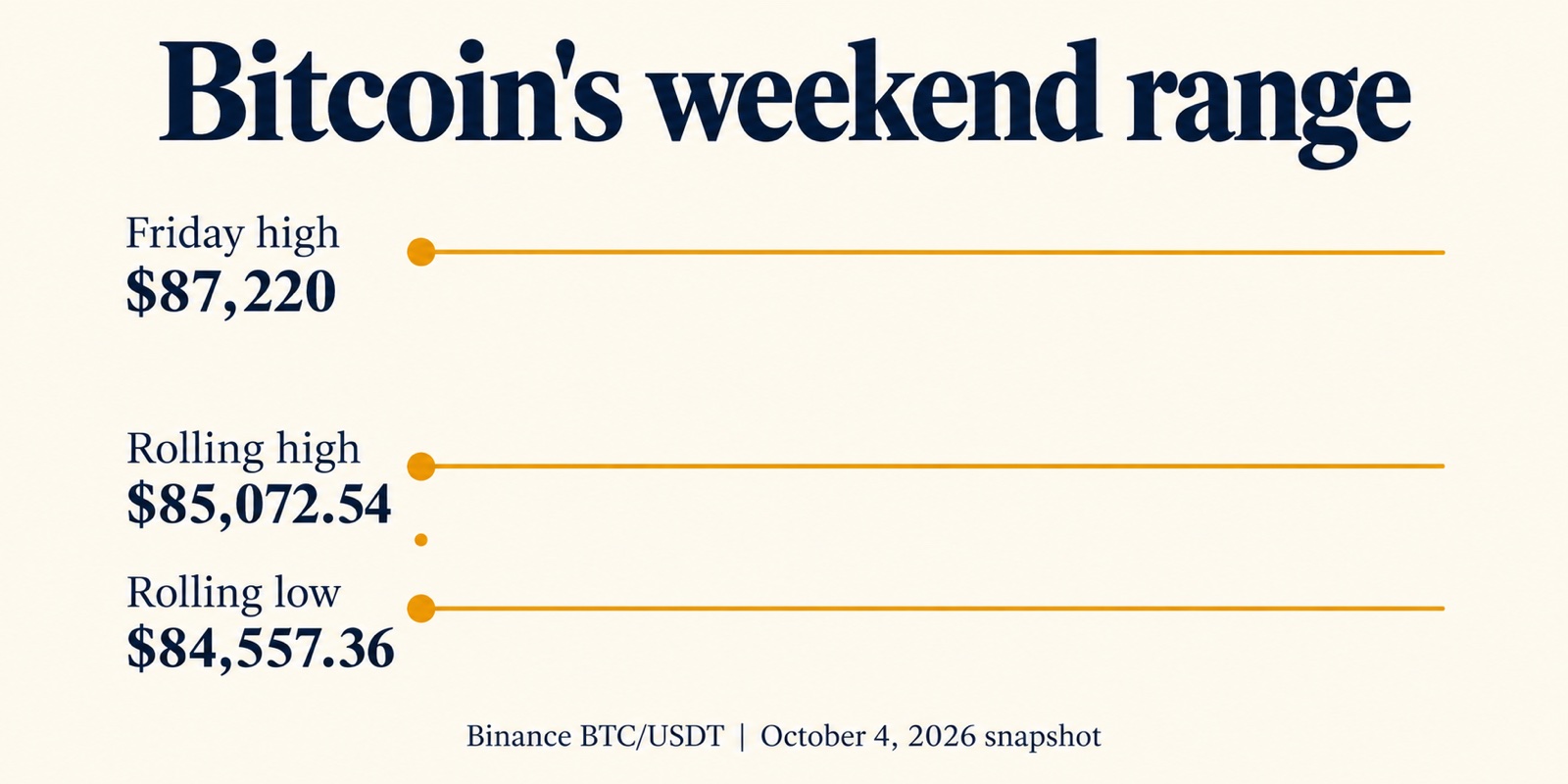
Binance BTC/USDT traded at $85,031.74, up 0.527% over its rolling 24-hour window. The snapshot’s high was $85,072.54 and its low was $84,557.36. That puts the last price close to the top of an unusually compact range, rather than above Friday’s much higher peak.
Research cutoff: October 4, 2026, 07:01:48 UTC. The ticker and daily-candle requests were retrieved shortly after 07:00 UTC; they are separate snapshots, not simultaneous trades. The official Binance market overview lets readers inspect current prices. Linked market pages show current data; the figures below are the historical research snapshot for this article. Prices can differ by exchange, quote currency and update time.
| Binance spot pair | Snapshot price in USDT | Rolling 24h change | Rolling 24h quote volume |
|---|---|---|---|
| BTC/USDT | 85,031.74 | +0.527% | 594.39 million USDT |
| ETH/USDT | 2,696.20 | +0.615% | 188.57 million USDT |
| SOL/USDT | 121.00 | +1.357% | 110.54 million USDT |
| BNB/USDT | 788.56 | +2.928% | 76.48 million USDT |
| XRP/USDT | 1.4975 | +0.815% | 64.76 million USDT |
These are five liquid pairs on one venue, not a full-market breadth survey. Their positive returns support the narrower statement that major Binance USDT pairs were recovering in the sampled window. They do not establish that the whole crypto market was gaining.
The $515.18 range equals about 0.61% of the rolling opening price. The last trade sat approximately $40.80 below the high. Those calculations explain the headline: Bitcoin was pressing against a nearby ceiling, but the ceiling itself was small. A quiet Sunday move should earn its significance through follow-through, not through how many green candles fit on a phone screen.
Why does low volume matter here?
Saturday’s completed BTC/USDT session traded 583.78 million USDT, versus 2.268 billion USDT on Friday. That is a 74.3% decline in quote volume between two completed UTC daily candles. It is a cleaner comparison than taking an unfinished Sunday candle and declaring trading activity has collapsed.
| Completed UTC session | High | Low | Close | BTC/USDT quote volume |
|---|---|---|---|---|
| October 2 | $87,220.00 | $83,888.00 | $84,518.01 | 2.268 billion USDT |
| October 3 | $85,037.63 | $84,456.02 | $84,753.56 | 583.78 million USDT |
Friday’s high-to-low excursion was $3,332. Saturday’s was $581.61. Price recovered modestly on Saturday, but it did so inside a much smaller range and with less turnover. Sunday’s ticker then showed a slight push above Saturday’s high.
Lower turnover does not prove buyers are weak. Weekends change the participant mix, and some institutional channels pause while spot exchanges keep running. It does mean that a small move has fewer traded dollars behind it on this pair. Treating that as equivalent to a heavily traded weekday reclaim discards useful information.
The rolling ticker’s 594.39 million USDT is close to Saturday’s daily turnover, but it covers a different interval. Its BTC window ends around 07:00 UTC Sunday and begins around the same time Saturday. Daily candles run midnight to midnight UTC. Mixing the two is how a reasonable observation turns into an unreasonable comparison.
Which Bitcoin levels actually matter?
The immediate test is $85,072.54; the larger unresolved obstacle is Friday’s $87,220 high. The following levels come from retrieved Binance prices and candles. They are reference points for conditional analysis, not promises that bids or offers will remain there.
| Price reference | Why it matters | What would change the interpretation? |
|---|---|---|
| $85,072.54 | Highest trade in the retrieved rolling window | Trading above it and retaining the level on a retest would strengthen the local rebound |
| $85,037.63 | Saturday’s completed UTC-session high | Sustained acceptance above it would distinguish a reclaim from a brief overshoot |
| $84,557.36 | Rolling-window low | Losing it would erase the tight-range recovery structure |
| $84,456.02 | Saturday’s completed UTC-session low | A break would shift attention back toward Friday’s lower range |
| $83,888.00 | Friday’s completed UTC-session low | Failure here would make the weekend bounce look less durable |
| $87,220.00 | Friday’s completed UTC-session high | A recovery toward it would require a much broader advance than today’s local breakout |
The order matters. Bitcoin cannot resolve Friday’s rejection merely by clearing a weekend high. At the ticker price, $87,220 remained about 2.57% overhead. That is achievable in a volatile asset, but it is still a different task from moving another $41.
One constructive scenario is that buyers hold above Saturday’s high and turnover expands when weekday participation returns. A weaker scenario is a quick move above $85,073 followed by a return into the range. The bearish scenario starts with lost nearby support and becomes more meaningful below Saturday’s low. None requires pretending a precise price level is a force field.
Does the latest ETF number confirm institutional buying?
Not conclusively: Farside showed a provisional $31.7 million total for October 2 while IBIT was still marked with a dash. Reported entries included $29.3 million for FBTC and $2.4 million for MSBT. The missing entry is not a verified zero, so neither Friday’s final aggregate nor a completed weekly total should be claimed from that table.
The Farside Bitcoin ETF flow table recorded $31.0 million on September 28, $66.2 million on September 29, minus $148.7 million on September 30 and $102.7 million on October 1. Those four displayed session totals sum to $51.2 million. Adding Friday’s displayed subtotal produces $82.9 million, still provisional because Friday was incomplete.
That is sufficient to say reported flows were positive overall in the visible record. It is insufficient to say institutions decisively confirmed Sunday’s advance. October 4 is a Sunday; it is not a new U.S. ETF trading session.

A flow record describes creations and redemptions across funds. It does not identify the buyer behind every spot trade. Likewise, a large wallet transfer does not automatically mean accumulation: custody reshuffling and exchange operations can move substantial balances without expressing a directional view. No new, independently verified October 4 whale-accumulation series was established in this research, so it is not used to explain today’s candle.
The right follow-up is to revisit the completed fund table and compare it with price acceptance. Reporting completeness and trading confirmation are separate tests.
Why are major pairs green while aggregate market cap is down?
The two datasets measure different universes and need not agree. CoinGecko’s retrieved global snapshot put total cryptocurrency market capitalization at $2.911 trillion, down 2.07% over 24 hours, with approximately $44.69 billion in reported volume and 58.60% Bitcoin dominance.
The CoinGecko global market charts provide the reader-facing aggregate view. Its snapshot covered thousands of assets across many venues, rather than the five Binance pairs above. Market capitalization also depends on circulating-supply estimates; pair returns measure traded prices against a specific quote currency.
Those distinctions are reasons to investigate the mismatch, not permission to invent a cause. The available snapshots do not isolate whether timing, coverage, supply revisions or weakness outside the sampled majors accounts for the difference. There is no defensible way to extract a precise number of declining coins from the global total alone.
BNB led the sampled group with a 2.928% gain, followed by SOL at 1.357%. That ranking is real within this comparison. Calling it an altcoin season would require broader evidence, a longer observation period and more than five positive rows. The market has enough slogans already.
Execution matters more in a narrow range
A $515 Bitcoin range leaves less room for execution mistakes than Friday’s $3,332 excursion. Before acting, distinguish a level touched once from a level accepted over time. Check available depth, expected slippage and the cost of entering and exiting. A limit order controls the worst price you accept, but it can remain unfilled; its maker status depends on whether it rests or immediately crosses the spread.
For readers comparing account options, create a Binance account with RATE20. The link pre-applies the referral code; review the displayed discount, eligibility and local product availability before registration. This is a referral link, and the site may benefit from qualifying signups.
The internal guide, Get 20% off with code RATE20, explains the advertised offer. Account discounts do not turn an unconfirmed price move into a good trade.
The official Binance announcement feed also listed a notice of spot-pair removals dated October 2. Pair availability and operational notices matter for execution, but the feed alone does not demonstrate that a platform update caused BNB’s gain. Check the specific instrument before placing orders or running a bot.
What should traders watch next?
The useful checklist is short:
- Does Bitcoin retain the $85,038–$85,073 area after testing above it?
- Does turnover expand against comparable completed sessions?
- Does the missing ETF entry get reported, and does the final total change the provisional reading?
- Does recovery extend beyond the five sampled pairs into the aggregate market?
A bullish answer to one item helps. Agreement across several would make the recovery more persuasive. The same discipline works in reverse: losing nearby support during renewed selling would matter more than another small Sunday uptick.
Avoid a false sense of urgency. A market open around the clock does not require a position around the clock. Waiting for stronger participation is itself a decision about evidence.
Frequently asked questions
What was Bitcoin’s price on October 4, 2026?
The retrieved Binance BTC/USDT ticker showed $85,031.74, up 0.527% over its rolling 24-hour window. This article preserves that snapshot; linked market pages display current figures and may now show different prices.
Were Bitcoin ETF flows positive on October 2?
Farside displayed a positive $31.7 million subtotal, but the record was incomplete because IBIT had a missing entry. Treat it as provisional rather than a finalized daily total. Sunday spot trading does not create a new Sunday U.S. ETF flow session.
Is Bitcoin’s move above $85,000 a confirmed breakout?
The retrieved data show a local weekend rebound, not confirmation that Friday’s $87,220 rejection has been resolved. Holding nearby highs with stronger participation would improve the setup; falling back through the weekend lows would weaken it.
Review Binance signup with referral code RATE20 →
The signup link pre-applies RATE20. Verify the terms shown for your account before completing registration.
This article is for informational purposes only and does not constitute financial advice. Always do your own research before making investment decisions.
Get 20% Off Binance Trading Fees with RATE20
New to Binance? Open the official signup page with RATE20 already applied for a 20% trading-fee discount. You do not need to copy or type the code. Review the referral details before completing registration.
- Referral code: RATE20, pre-applied by this link
- Fee discount: 20%, shown on the Binance signup screen
- Additional rewards: Check Binance for current promotions and regional availability
Be wary of unofficial referral offers promising benefits they cannot show. The Binance signup screen lets you check the code and fee discount directly.
Compare Binance fees and available discounts →
SmallDrift may earn a commission when you sign up through this link. Trading involves risk, including loss of capital.
Related Articles



Explore Related Guides
Daily Crypto Market News
Follow Bitcoin price moves, major altcoins, and the events shaping the market.
Bitcoin ETF Flows Guide
Understand ETF inflows and outflows, and how to read them alongside price action.
Binance Fee Calculator
Learn how to estimate trading costs with referral and BNB discounts.
Verified Binance Referral Guide
See how RATE20 is applied and what to check on the Binance signup screen.