Bitcoin's $80K Fed Test: What Counts — October 28, 2026
Bitcoin rebounds to 80,889 USDT before the Fed decision. ETF inflows help, but the local trading range and conflicting market snapshots need care.
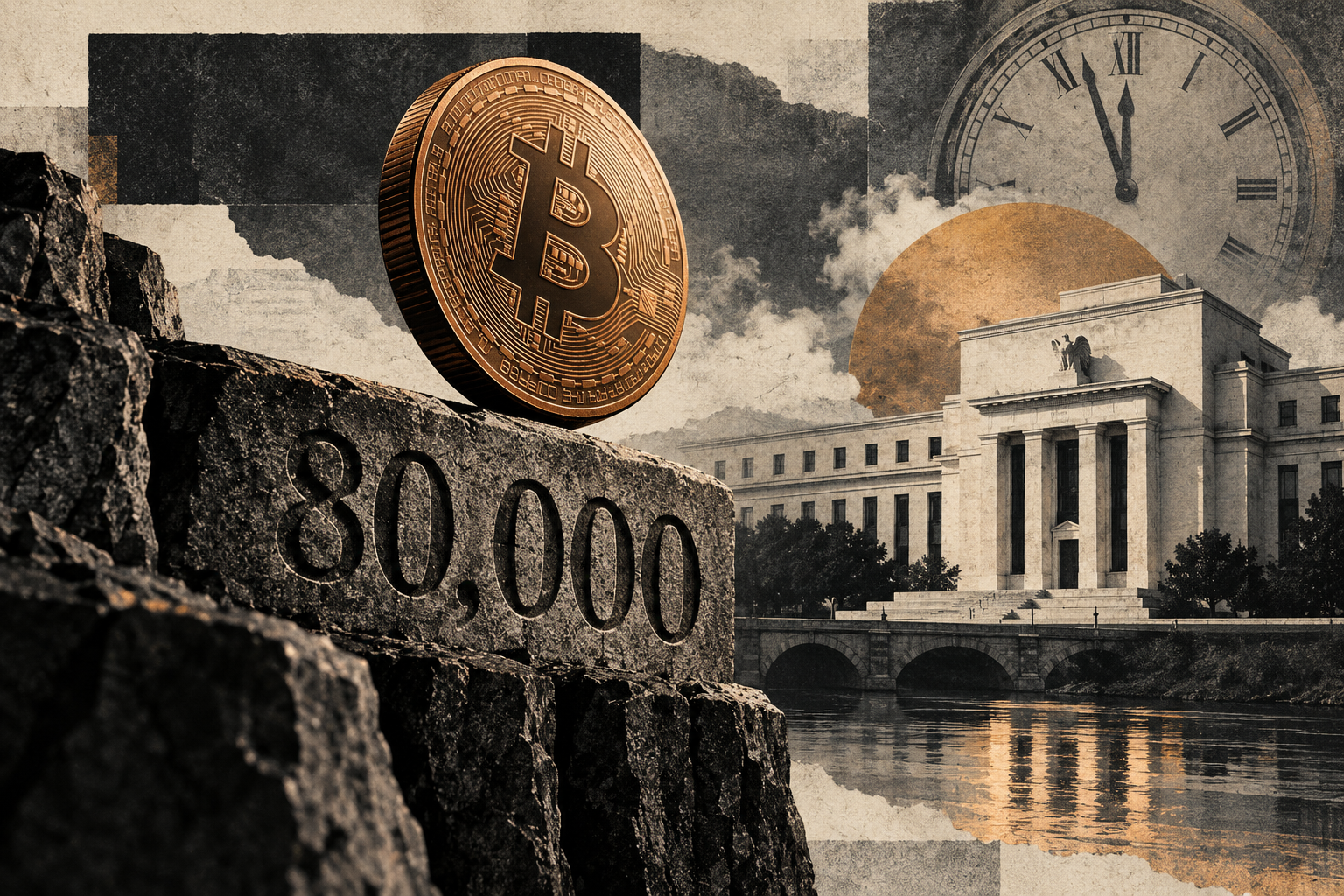
Bitcoin is back above 80,000 USDT before the Fed decision, but the rebound has not cleared its own daily ceiling. BTC/USDT gained 1.581% over its rolling 24 hours while the latest completed U.S. session brought another positive Bitcoin ETF flow. For traders watching October 28, the useful question is whether that improvement survives the policy news and a test of 81,300.
Research cutoff: 07:04:22 UTC on October 28, 2026. Binance spot and CoinGecko API responses were retrieved at approximately 07:01:05 UTC. Binance figures refer to USDT pairs and rolling 24-hour windows ending around 07:01:04–07:01:05 UTC, not calendar-day returns. ETF data cover completed U.S. sessions through October 27. Linked market pages show current data; they may differ from the historical snapshot saved for this article. One material provider-page discrepancy is explained below.
What is Bitcoin’s price on October 28?
BTC/USDT was 80,888.57 USDT in the saved Binance snapshot. Its rolling high was 81,300 and its low was 79,506. The move therefore recovered the round-number 80,000 area without establishing a breakout above the measured range.
The official Binance market overview is the reader-readable reference for the spot pairs below. These are exchange-specific quotes. USDT is the quote asset, so a figure in this table should not be treated as an exact consolidated U.S.-dollar price across every venue.
| Binance spot pair | Last price, USDT | Rolling 24h change | Rolling 24h low–high | Quote turnover, USDT |
|---|---|---|---|---|
| BTC/USDT | 80,888.57 | +1.581% | 79,506–81,300 | 985.07M |
| ETH/USDT | 2,352.61 | +2.134% | 2,297.44–2,369.26 | 488.24M |
| SOL/USDT | 102.04 | +2.522% | 99.16–102.44 | 128.95M |
| BNB/USDT | 744.50 | +1.275% | 734.09–754.29 | 76.87M |
All four pairs were positive on this measurement. Solana led the percentage gains, followed by Ether, Bitcoin and BNB. That is evidence of a recovery within this small group; four large assets are too narrow a sample to establish an altcoin season or a market-wide buying wave.
Quote turnover also needs a careful reading. Bitcoin’s 985.07 million USDT represents trading activity in one pair during the window. It is neither net inflow nor a measure of how much fresh investor money entered Bitcoin. Every completed trade has a buyer and a seller. A large turnover number cannot tell you which side is more patient.
The 81,300 test is closer than the headlines suggest
The nearest observed upside reference is 81,300, just 411.43 USDT above the snapshot price. That is about 0.51%. The rolling low is 1,382.57 USDT below the snapshot, about 1.71%. Neither distance estimates the likelihood of reaching the level.
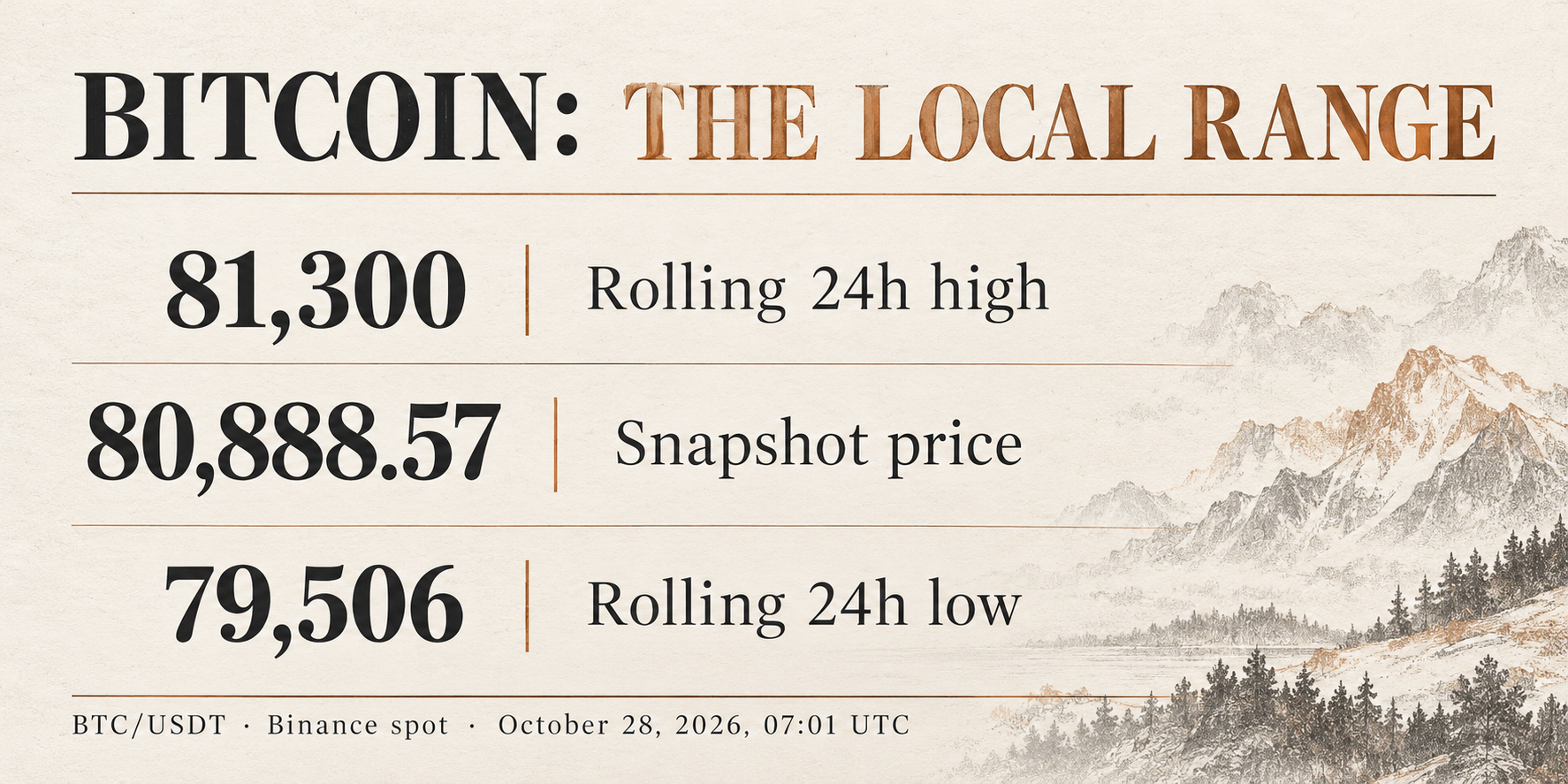
AI-generated reference graphic based on the saved Binance spot snapshot. It depicts levels, not an intraday price path or a forecast.
| Reference | Level, USDT | What would make it useful? |
|---|---|---|
| Rolling high | 81,300 | A move above it followed by sustained trading would improve the local breakout case. |
| Round-number reference | 80,000 | Holding above it would preserve the immediate recovery narrative. |
| Rolling low | 79,506 | Trading below it would invalidate the claim that this measured range is still containing price. |
These are working references derived from the response, rather than independently validated technical support or resistance. A 24-hour extreme tells you where price has traded. It does not reveal how many resting orders remain there, whether buyers will return, or where a large participant must transact next.
The distinction matters on a policy day. A brief move above a recent high can attract momentum orders and then reverse. A break below a round number can recover just as quickly. Watching whether price remains outside the range after the initial move provides more information than treating the first touch as a verdict.
A practical reading is conditional: acceptance above 81,300 would strengthen the rebound; a failure there followed by a loss of 80,000 would weaken it. A move through 79,506 would require a fresh map. None of those scenarios is a promise, and the range will change as the rolling window advances.
ETF buying returned, but the repair is incomplete
Farside reports a 176.0 million dollar net inflow for October 27, following 110.3 million on October 26. The Bitcoin ETF flow table therefore shows 286.3 million dollars of buying across those two sessions.
| Completed U.S. session | Net Bitcoin ETF flow, USD millions |
|---|---|
| October 22 | -635.6 |
| October 23 | -137.9 |
| October 26 | +110.3 |
| October 27 | +176.0 |
The two positive sessions replaced about 37.0% of the preceding two sessions’ 773.5 million dollar exit. Across these four sessions, the balance remains negative by 487.2 million dollars. These calculations use the displayed daily totals and may change if the source revises them.
That supports a narrower conclusion than “institutions are back”: demand improved, while recent redemptions remain only partly repaired. October 28 has no completed U.S. session total at this cutoff. ETF flow is a daily fund measure, not a live Bitcoin order-book signal.
Why the global market numbers need a separate clock
The saved CoinGecko API response and its reader-facing charts page did not match during this research. The response contained approximately $2.728 trillion in total capitalization, a -1.441% 24-hour change and 59.402% Bitcoin dominance. Its provider update timestamp was 06:52:35 UTC, before the retrieval time.
When checked separately, the CoinGecko global charts page displayed about $2.81 trillion, a +1.32% 24-hour change and 57.81% Bitcoin dominance. Those differences are material. This article does not merge the two observations, infer a historical change between them, or choose whichever makes the cleaner headline.
Different update times, delivery paths or coverage could explain a mismatch, but the available evidence does not establish the cause here. The honest conclusion is that the global aggregate is unsuitable for confirming the exchange rebound in this particular research snapshot.
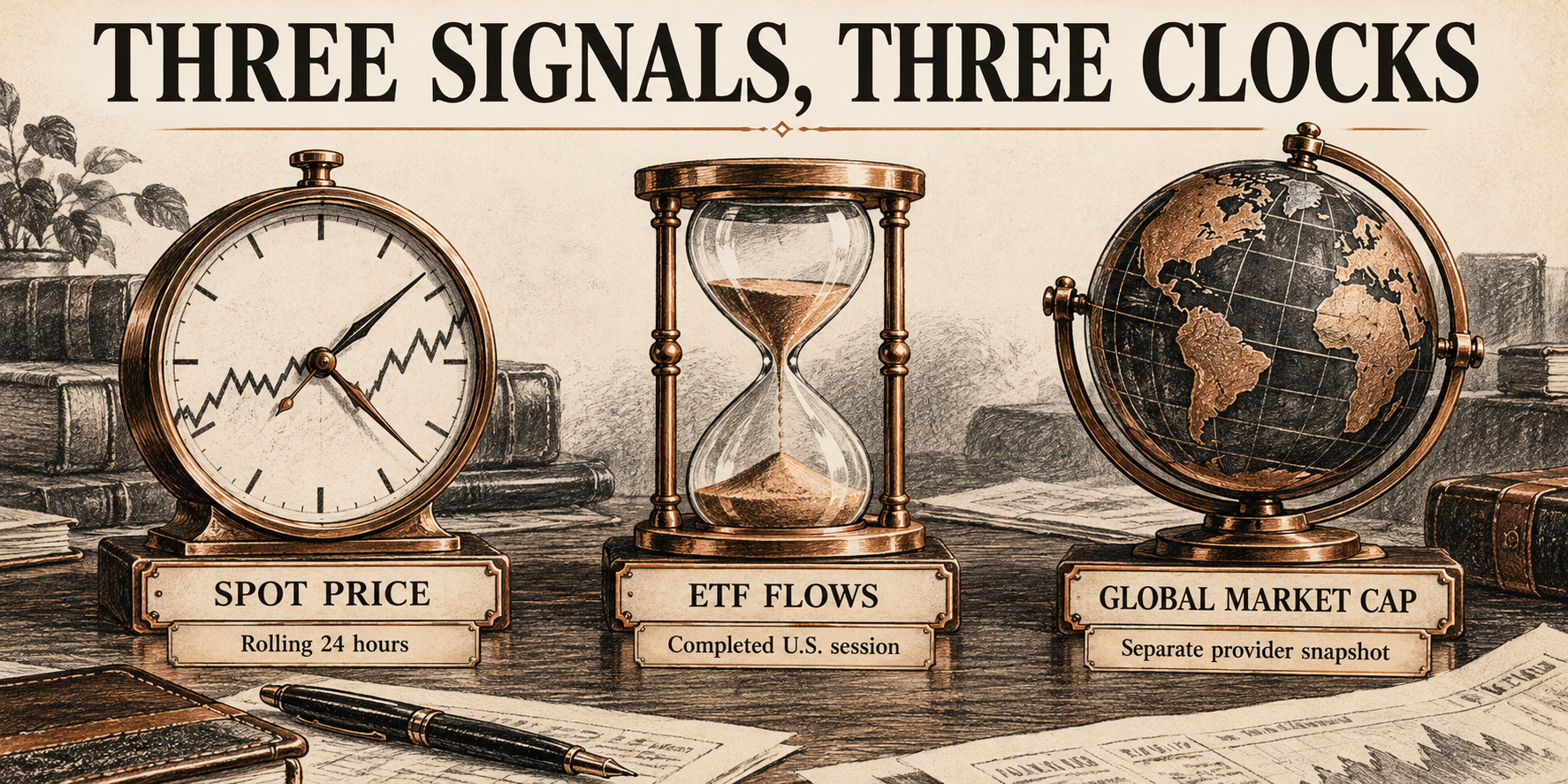
AI-generated explanatory illustration. Spot prices, fund flows and global capitalization are different measurements with different timing.
This is also why a market-cap change should not be called money entering or leaving crypto. Capitalization depends on prices and circulating supply. It can move sharply without an equivalent amount of cash changing hands. For the immediate trading question, the internally consistent Binance pair data provide the clearer local reference, while the aggregate discrepancy remains a limitation.
What the Fed can change today
The official calendar places the FOMC meeting on October 27–28. The Federal Reserve meeting calendar also shows that this meeting is not one of the scheduled Summary of Economic Projections meetings. At this research cutoff, the calendar did not provide an October decision statement.
That means the article is a pre-decision assessment. It does not report a rate outcome or attach an unverified probability to a hike, hold or cut. The policy announcement and the explanation around it can change expectations for future financing conditions, which in turn can change the amount of risk investors want to hold.
For Bitcoin, the relevant transmission is broader than the headline rate. A message implying tighter conditions for longer can raise the return investors demand from risky assets. A less restrictive outlook can work in the other direction. Those are mechanisms, not a rule that Bitcoin must follow on every announcement.
Watch the relationship between the message and the price response. A seemingly favorable announcement that cannot push BTC beyond its nearby high would suggest that sellers still have supply to offer. A disappointing message followed by a recovery above a lost level would suggest buyers are absorbing the shock. Both interpretations need price evidence after the news.
There is no verified current whale-flow series in this article. Search results about large holders are insufficient to establish that whales caused this rebound. A large wallet transfer can involve custody, collateral or internal exchange movements; it is not automatically a spot purchase. The causal story should stay smaller than the evidence.
Binance execution: check the instrument before the order
The official Binance announcement center was checked for exchange-specific updates. Its changing feed included notices about spot trading services and futures trading rules. A date in an announcement title can refer to an effective date, so the detail page and exact contract or pair matter before acting.
An exchange product update does not explain a Bitcoin rally by itself. Its immediate relevance is operational: confirm that your intended instrument is available, understand its trading rules, and check whether maintenance or a parameter change affects the order you plan to place. Spot and perpetual futures are different exposures even when their ticker names look familiar.
For readers choosing Binance where available, account setup should come before a fast market forces rushed decisions. Create a Binance account with RATE20. The link pre-applies the referral code; review the displayed eligibility and fee-discount terms before registration. This is a referral link.
Our guide explains the offer and the checks to make: Get 20% off with code RATE20. Availability and applicable terms depend on the account and jurisdiction.
Keep trading costs separate from the market thesis
A small target leaves less room for execution costs. At the snapshot price, the gap to the rolling high was roughly half a percent. Fees, the bid–ask spread and slippage can consume part of that distance, especially if a trader repeatedly enters and exits around a news release.
A limit order can control the worst price you accept, but it may remain unfilled. It also does not automatically qualify as a maker order: an immediately executable limit order can take liquidity. Paying fees with BNB and referral benefits depend on applicable product terms; neither should be assumed to apply identically to every account or derivatives contract.
Before placing an order, write down the intended exposure, the condition that would invalidate the trade and the maximum loss you can tolerate. A lower fee improves execution economics. It cannot repair an oversized position or a thesis that depends on a guaranteed Fed reaction.
Review Binance registration with referral code RATE20 and confirm the offer shown on the registration screen. There is no need to turn a pre-decision market view into an immediate trade.
Frequently asked questions
Is Bitcoin above $80,000 on October 28, 2026?
Yes: the saved Binance BTC/USDT quote was 80,888.57 USDT at approximately 07:01 UTC. It was a historical exchange snapshot, not a continuously updated dollar quote. The relevant rolling range was 79,506–81,300 USDT.
Does the rebound confirm a Bitcoin breakout?
No: the snapshot remained below its rolling 24-hour high of 81,300. Sustained trading beyond that reference would provide stronger local evidence. A recent high alone is not a guaranteed resistance level.
What is the main risk before the Fed decision?
The main immediate risk is that policy news changes expectations faster than the current range can absorb. ETF demand, exchange prices and global market aggregates operate on different clocks. Judge the post-announcement price response against updated levels, rather than assuming yesterday’s fund buying settles today’s direction.
This article is for informational purposes only and does not constitute financial advice. Always do your own research before making investment decisions.
Get 20% Off Binance Trading Fees with RATE20
New to Binance? Open the official signup page with RATE20 already applied for a 20% trading-fee discount. You do not need to copy or type the code. Review the referral details before completing registration.
- Referral code: RATE20, pre-applied by this link
- Fee discount: 20%, shown on the Binance signup screen
- Additional rewards: Check Binance for current promotions and regional availability
Be wary of unofficial referral offers promising benefits they cannot show. The Binance signup screen lets you check the code and fee discount directly.
Compare Binance fees and available discounts →
SmallDrift may earn a commission when you sign up through this link. Trading involves risk, including loss of capital.
Related Articles



Explore Related Guides
Daily Crypto Market News
Follow Bitcoin price moves, major altcoins, and the events shaping the market.
Bitcoin ETF Flows Guide
Understand ETF inflows and outflows, and how to read them alongside price action.
Binance Fee Calculator
Learn how to estimate trading costs with referral and BNB discounts.
Verified Binance Referral Guide
See how RATE20 is applied and what to check on the Binance signup screen.