Bitcoin’s $643M ETF Exit: October 31, 2026 Market Test
Bitcoin trades near $77,338 after a $643.2 million ETF outflow. Binance’s withdrawal suspension adds a separate test of weekend liquidity and trust.

Four days of Bitcoin ETF inflows disappeared under one $643.2 million Friday exit. Bitcoin still traded near 77,338 USDT in Saturday’s snapshot, while Binance’s withdrawal suspension introduced a separate liquidity concern. The weekend question is whether buyers can defend the trading range while access to funds remains part of the story.
Research cutoff: October 31, 2026, 10:50 UTC. Spot quotes below were retrieved at 07:58:44–07:58:45 UTC. They are historical research snapshots; linked market pages show current data and can differ from these figures. The Binance figures use USDT pairs and rolling 24-hour windows, not UTC daily candles or consolidated dollar prices.
What is Bitcoin’s price today?
BTC/USDT was 77,338.02, down 1.039% over its rolling 24-hour window. Its observed low and high give us practical reference points for the weekend. Neither boundary guarantees that buyers or sellers will appear again.
| Binance spot pair | Last price, USDT | Rolling 24h change | Rolling low | Rolling high |
|---|---|---|---|---|
| BTC/USDT | 77,338.02 | -1.039% | 76,325.98 | 78,241.30 |
| ETH/USDT | 2,243.33 | +0.367% | 2,208.40 | 2,262.49 |
| SOL/USDT | 95.58 | -1.798% | 93.62 | 97.61 |
The windows run from October 30 to October 31 at approximately 07:58:44 UTC. See the official Binance market overview for updated prices; its aggregate displays may use different coverage from these single-pair tickers.
Ether’s relative strength and Solana’s weakness do not describe a uniform rebound. A few green prices can coexist with defensive positioning elsewhere. For traders watching rotation, sustained performance across several sessions would be more persuasive than this single comparison.
Bitcoin sat roughly halfway between its observed extremes. That matters because a market can look stable at the headline level while remaining vulnerable in either direction. A price near the middle of yesterday’s range gives neither breakout buyers nor breakdown sellers much confirmation.
How did four positive ETF days become a negative week?
Friday’s redemptions exceeded the previous four sessions’ combined inflows. The Farside Investors daily table shows these US spot Bitcoin ETF totals in millions of dollars:
| Session | Net flow, USD millions |
|---|---|
| October 26 | +110.3 |
| October 27 | +176.0 |
| October 28 | +137.3 |
| October 29 | +17.2 |
| October 30 | -643.2 |
| Week, calculated | -202.4 |
The first four sessions added $440.8 million. Friday removed about 1.46 times that amount. Four positive sessions sounded reassuring; the arithmetic had other plans.
These are fund-flow observations, subject to revisions. They do not identify every investor’s motive or establish the timing of underlying spot transactions. A daily redemption total cannot, by itself, prove that one news event caused the selling.
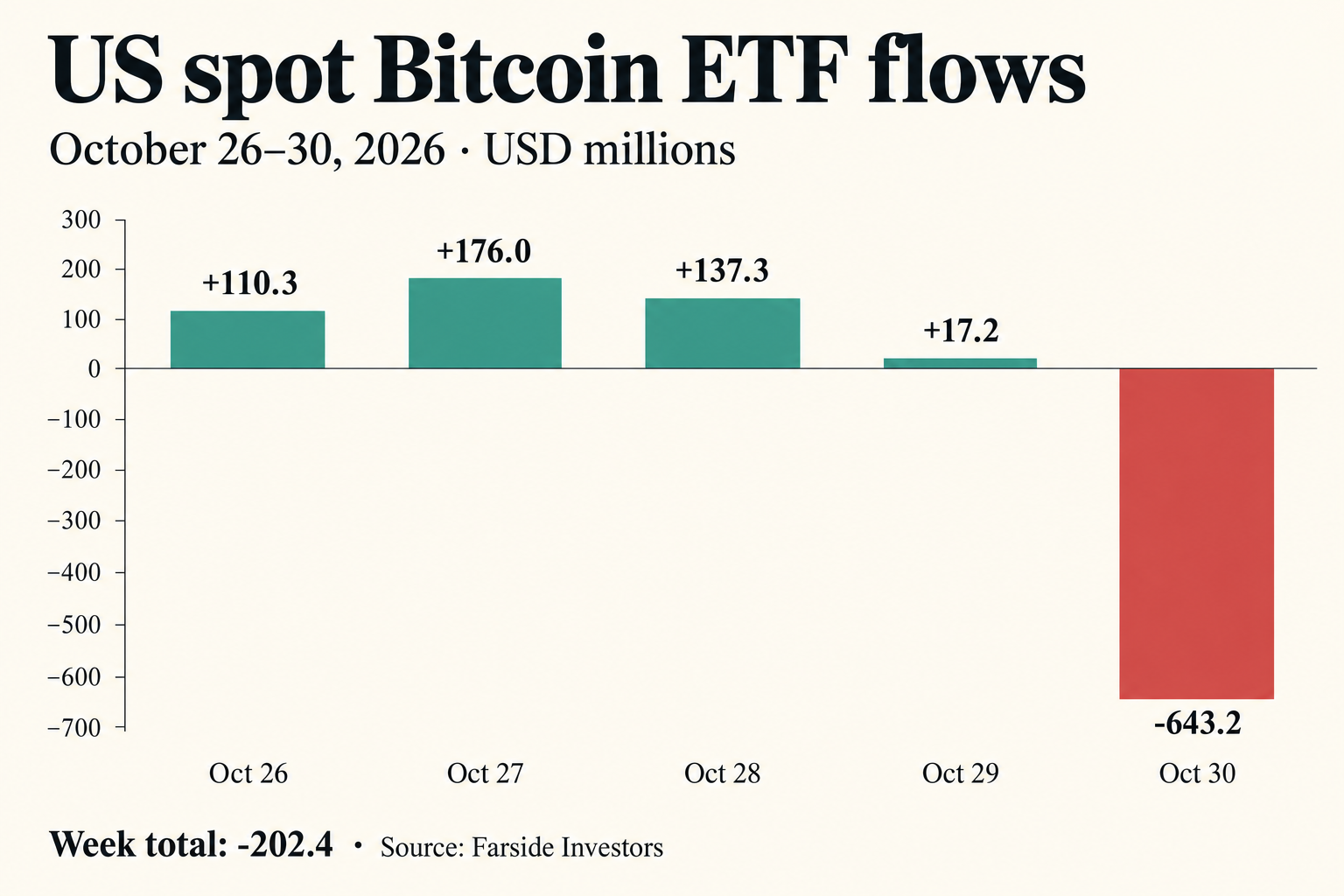
The analytical implication is straightforward: counting green days can conceal the size of the red day. A recovery thesis needs evidence that fresh demand can absorb supply, rather than a comforting streak statistic. Monday’s next available flow reports will help assess that question; Saturday cannot supply a new completed US ETF trading session.
Binance’s incident changes what a market quote can tell you
Binance’s latest reviewed update said withdrawals remained suspended. Its official security incident notice reported approximately $6.3 billion in stolen assets and said deposits and unaffected services remained operational.
The company said it had earmarked more than $6.34 billion, including $5 billion in affected token assets, and that roughly $3 billion had been frozen on-chain. Those are company statements, not an independent solvency audit. Frozen assets are not necessarily recovered funds, and earmarked capital is not the same as an independently verified liability match.
The notice described a conditional, phased withdrawal restart target and planned reserve reporting by November 2. These were plans at the cutoff, not completed milestones. Its investigation was continuing; attributing the incident to one definitive technical cause would be premature.
This creates a distinction readers need to keep in mind: an available ticker establishes that a price was returned. It does not establish that every customer can transfer assets out. The operational status of an exchange and the direction of a coin’s price answer different questions.
A disrupted transfer route can also complicate interpretation of venue prices. Arbitrage normally depends on the ability to move inventory or capital. When that ability is constrained, a local quote may deserve extra scrutiny against other venues before it becomes the foundation of a market-wide conclusion.
Nothing in the snapshot establishes that such a dislocation occurred. It establishes why checking for one is useful. The same discipline applies to claims of a rescue bid: an exchange’s replacement purchases cannot automatically be treated as unrestricted new investor demand.
The broader market provides little comfort
The retrieved CoinGecko global snapshot put total capitalization at $2.619 trillion, down 3.904% over 24 hours, with $80.70 billion in reported turnover. Bitcoin’s capitalization share was 59.23%. The response’s update time was 07:55:24 UTC, earlier than its retrieval at 07:58:45 UTC.
The CoinGecko global charts provide the reader-facing view. Their live totals can differ because the page and API are not necessarily refreshed together. We retain the original response rather than mixing a later page value into this earlier snapshot.
Those figures describe a defensive backdrop. They do not demonstrate that capital flowed directly from altcoins into Bitcoin: capitalization changes combine price movements and supply effects, and dominance is a ratio. Likewise, reported turnover is not equivalent to executable order-book depth.
That last distinction becomes useful during a confidence shock. A market can print substantial volume while the quantity available near the best bid remains small. If a trader needs to exit quickly, the available price for their actual order size matters more than the day’s headline turnover.
Which Bitcoin levels matter this weekend?
The observed range is 76,325.98–78,241.30 USDT. These levels come directly from the retrieved ticker. The following scenarios are the author’s interpretation, not model outputs or verified predictions.
| Reference | Why watch it? | What would make the observation useful? |
|---|---|---|
| 76,325.98 | Rolling 24h low | Whether a revisit attracts bids or selling persists below it |
| 77,338.02 | Retrieved last price | A fixed comparison point for subsequent observations |
| 78,241.30 | Rolling 24h high | Whether a move above it holds on later observations |
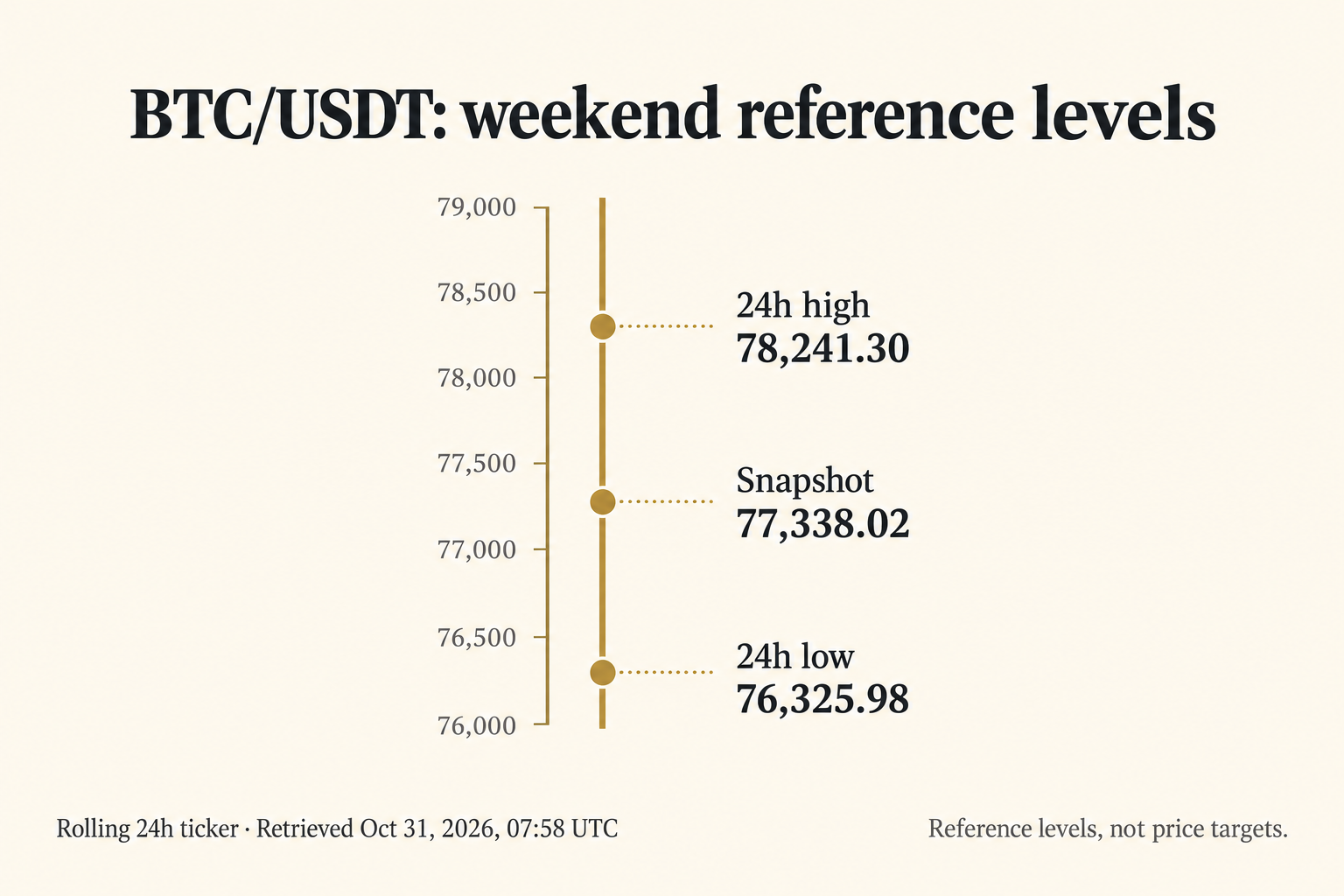
A constructive scenario would involve price recovering the upper boundary and retaining that ground while operational uncertainty eases. A brief wick above the high would be weaker evidence than repeated trading above it with observable depth.
A defensive scenario would involve persistent trading below the lower boundary, particularly if transfers remain constrained or liquidity becomes harder to access. There is no defensible next support target in this research set. Inventing one would give a thin dataset an undeserved air of precision.
The neutral scenario is continued trading inside the range. That may feel uneventful, but it would leave both the demand question and the operational question unresolved. Patience is a position with an unusually low transaction count.
A practical checklist before placing an order
Start with access, then execution, then direction. If your plan depends on withdrawing immediately after a trade, verify that the exact asset and network are available before committing funds. A general platform status message may not answer that specific question.
Next, inspect the bid–ask spread and the depth relevant to your order size. A limit order lets you specify a price, but it may remain unfilled. A market order seeks immediate execution and can cross several price levels. Neither order type removes custody or transfer risk.
Finally, decide which observation would invalidate the trade. If the plan requires a clean break of the range, a price still inside it does not satisfy the condition. Reducing the number of decisions can be more useful than increasing the number of indicators.
We did not obtain a verified wallet-cohort dataset for this cutoff. There is therefore no whale-accumulation claim here. A large transfer may reflect internal wallet maintenance, custody movements or trading activity; its size alone does not reveal a directional bet.
If you choose to register, check service status first
This article contains affiliate links. SmallDrift may receive a commission from eligible registrations. Given the reported withdrawal suspension, registration should not be read as a recommendation to deposit funds during the incident.
Review Binance registration with code RATE20 →
The link pre-applies RATE20. Confirm the displayed referral benefit, eligibility and local availability before completing signup. Our guide explains the offer: Get 20% off with code RATE20. A referral benefit does not offset losses from price movements or service interruptions.
What would improve the evidence by Monday?
Three developments would make the market easier to assess: verified restoration of withdrawals, published information that allows reserve claims to be examined, and subsequent ETF reports showing whether Friday’s selling persists. Each addresses a different uncertainty.
Price strength without improved access would leave the operational question open. Improved access without renewed demand could still leave Bitcoin struggling against selling pressure. A durable recovery would be more convincing if both the plumbing and the buying improved together.
Until then, treat the latest headlines as inputs to a decision, not substitutes for one. The snapshot supports a measured conclusion: Bitcoin was holding inside its recent range despite a negative ETF week and an exchange security shock. It does not support declaring the incident resolved or a lasting bottom established.
Frequently asked questions
Why is Bitcoin under pressure on October 31, 2026?
The observed backdrop combines ETF selling and exchange security uncertainty. These are relevant risk factors, but this research does not establish how much either contributed to a specific price move. The ticker records a decline, not its cause.
Is 76,326 USDT confirmed Bitcoin support?
No; it is the rounded low of the retrieved rolling 24-hour BTC/USDT window. It is a useful reference for a later retest, while confirmed support would require additional evidence of buying around that area.
Have Binance withdrawals fully resumed?
The latest official notice reviewed at the cutoff still described a suspension and a conditional restart plan. Check current official service information before relying on transfers; the article does not assume a later restoration has occurred.
For readers considering a future account after reviewing current service conditions: Open Binance registration with RATE20 →. Check the offer shown during signup before relying on any discount.
This article is for informational purposes only and does not constitute financial advice. Always do your own research before making investment decisions.
Get 20% Off Binance Trading Fees with RATE20
New to Binance? Open the official signup page with RATE20 already applied for a 20% trading-fee discount. You do not need to copy or type the code. Review the referral details before completing registration.

- Referral code: RATE20, pre-applied by this link
- Fee discount: 20%, shown on the Binance signup screen
- Additional rewards: Check Binance for current promotions and regional availability
Be wary of unofficial referral offers promising benefits they cannot show. The Binance signup screen lets you check the code and fee discount directly.
Compare Binance fees and available discounts →
SmallDrift may earn a commission when you sign up through this link. Trading involves risk, including loss of capital.
Related Articles



Explore Related Guides
Daily Crypto Market News
Follow Bitcoin price moves, major altcoins, and the events shaping the market.
Bitcoin ETF Flows Guide
Understand ETF inflows and outflows, and how to read them alongside price action.
Binance Fee Calculator
Learn how to estimate trading costs with referral and BNB discounts.
Verified Binance Referral Guide
See how RATE20 is applied and what to check on the Binance signup screen.