$261M ETF Exit Tests $80K Bitcoin — October 15, 2026
Bitcoin nears $80K after $261.4M in ETF outflows. Ethereum and Solana fall faster as traders watch the rolling low and the $82K recovery hurdle.

Bitcoin is less than 1% above its rolling 24-hour low after U.S. spot Bitcoin ETFs shed $261.4 million on October 14. Ethereum and Solana are falling faster, making this a test of demand across the market rather than a Bitcoin-only wobble. The question for October 15 is whether the $80,000 area attracts durable buyers or merely provides a convenient place for the next bounce to fail.
Research cutoff: October 15, 2026, at 07:02:13 UTC. Exchange prices below were retrieved at 07:00:48 UTC and represent Binance spot USDT pairs over their rolling 24-hour windows, approximately October 14–15 at 07:00:48 UTC. USDT quotes are not a separate USD benchmark. ETF figures refer to dated U.S. sessions. Linked market pages show current data and can differ from this fixed historical snapshot.
What is the crypto market doing on October 15?
The four large spot pairs sampled are all lower, with ETH showing the weakest 24-hour return. These figures come from a saved Binance ticker response; the official Binance market overview provides a readable live reference. Its broader market figures should not be confused with individual pair turnover.
| Binance spot pair | Last price, USDT | Rolling 24h change | Rolling low–high, USDT | Pair quote turnover |
|---|---|---|---|---|
| BTC/USDT | 80,968.76 | -2.932% | 80,226.35–84,146.72 | 1.950B USDT |
| ETH/USDT | 2,359.98 | -5.769% | 2,318.00–2,530.44 | 1.140B USDT |
| SOL/USDT | 102.34 | -4.462% | 100.62–108.67 | 307.71M USDT |
| BNB/USDT | 718.28 | -3.249% | 708.64–747.00 | 103.57M USDT |
Bitcoin sits about 0.93% above its rolling low and roughly 3.78% below its rolling high. That positioning matters more than the rounded headline price: buyers have recovered only a small portion of the window’s range. A price beginning with “80” can sound like a bargain without telling you whether the selling has finished.
ETH trails BTC by 2.837 percentage points over approximately matched windows. SOL trails by 1.530 points, while BNB trails by 0.317 points. This is evidence of relative weakness within this sample, not proof that every altcoin is falling or that a full-market breadth indicator has triggered.
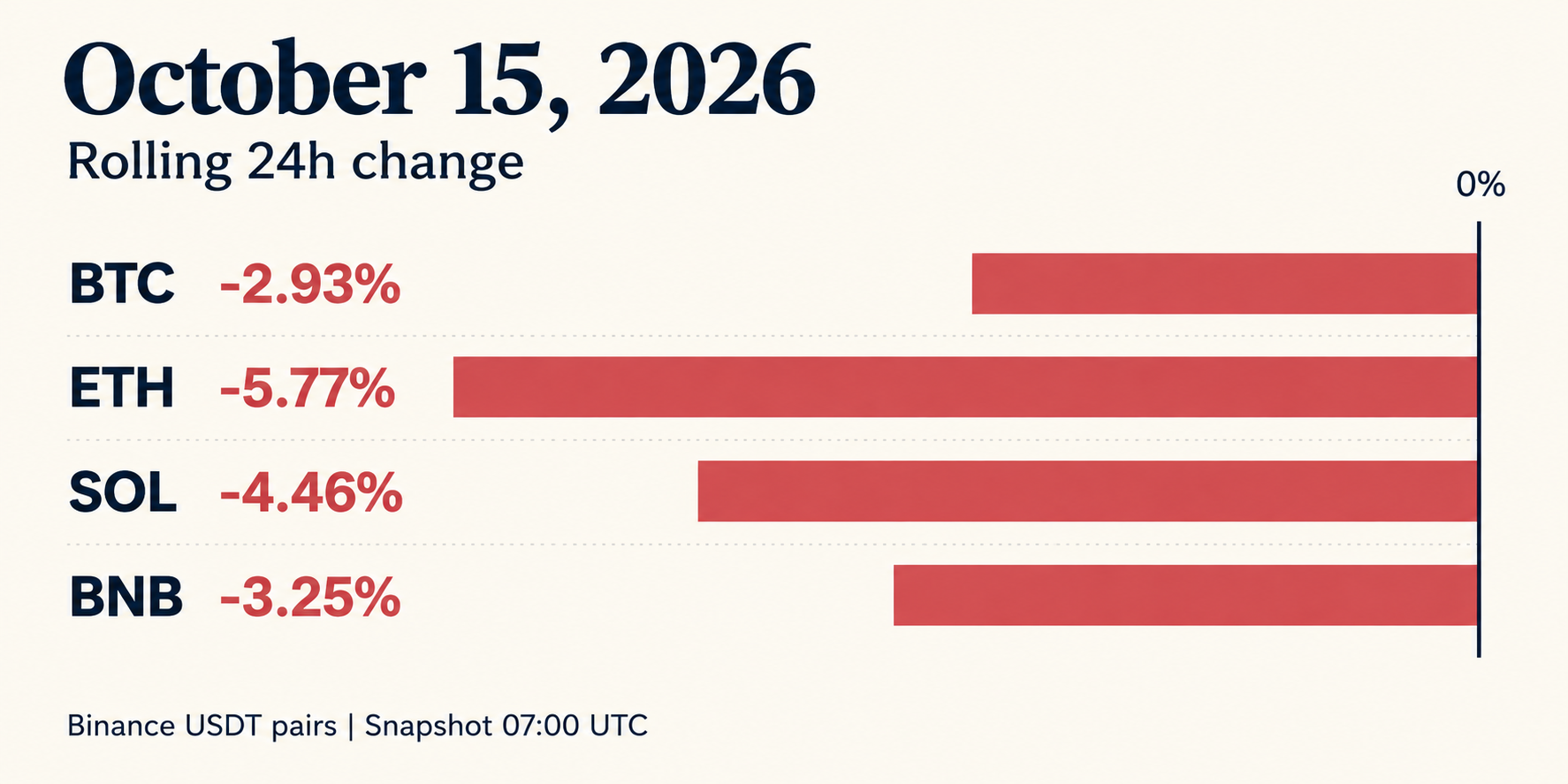
The implication is straightforward. An isolated Bitcoin bounce would be less persuasive if ETH and SOL keep making fresh lows. A broader recovery would require more than the largest asset briefly turning upward. Traders need to distinguish a rebound in one price from improvement across several independent markets.
Why does the $261.4 million ETF outflow matter?
October 14’s withdrawals more than erased October 13’s $175.7 million inflow. Farside Investors’ daily Bitcoin ETF table records these net flows in millions of U.S. dollars:
| U.S. session | Spot Bitcoin ETF net flow |
|---|---|
| October 12, 2026 | -$65.4M |
| October 13, 2026 | +$175.7M |
| October 14, 2026 | -$261.4M |
| Three-session sum, calculated | -$151.1M |
The October 14 total comprises $152.7 million leaving FBTC and $110.9 million leaving IBIT, partially offset by $2.2 million entering BITB. Those two withdrawals sum to $263.6 million. Farside’s table is automatically updated and subject to revision; this article preserves the displayed observations at research time.
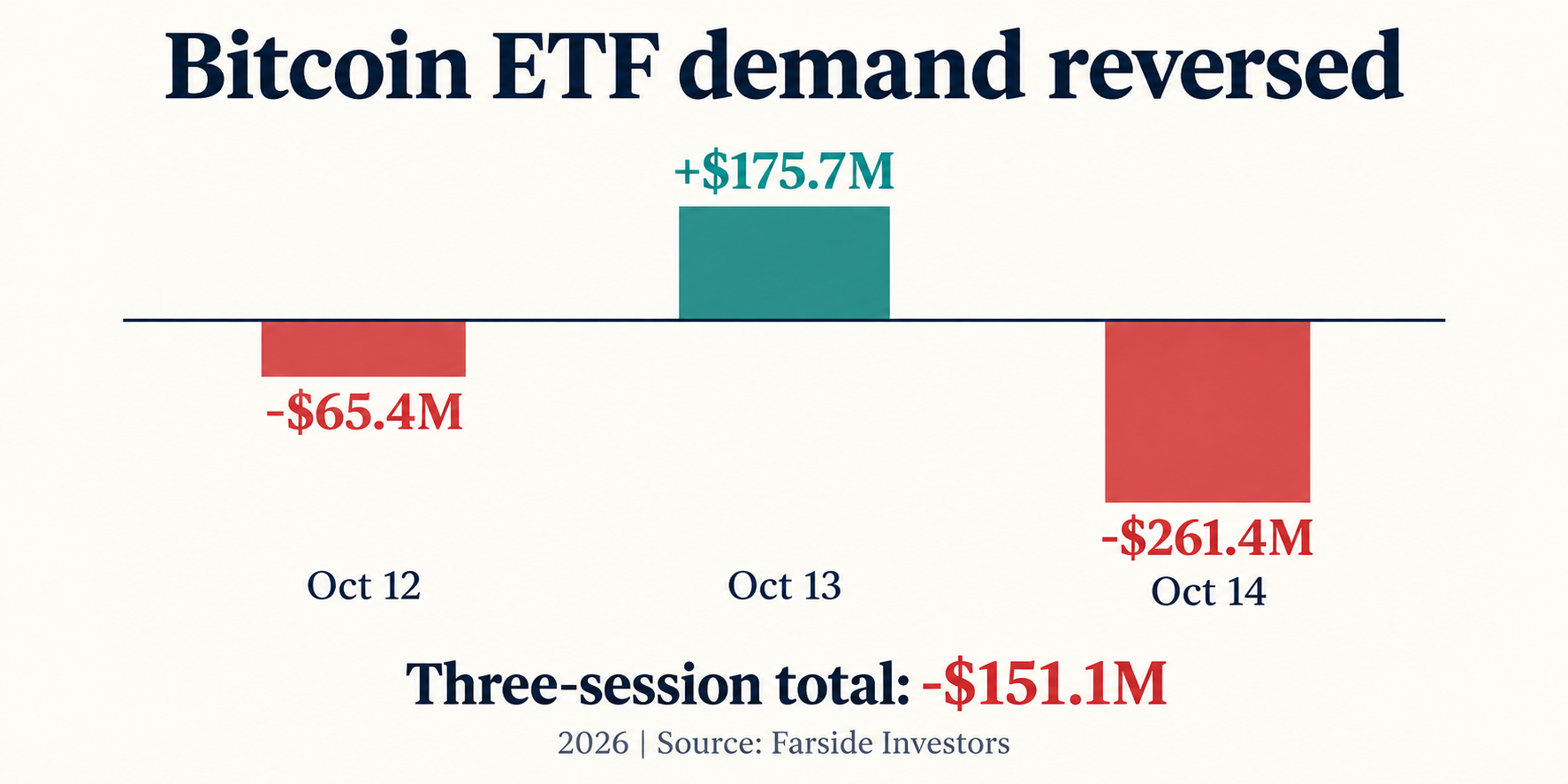
One positive session was insufficient to reverse the three-session balance. That weakens the argument that institutional demand had already stabilized. It does not establish who sold spot Bitcoin at a particular minute or prove that ETF redemptions caused the entire price move. Fund flows and an exchange’s rolling return measure different things over different clocks.
There is another distinction worth keeping: net flows are changes in fund demand, not the value of every share traded on a stock exchange. Heavy ETF share turnover can coexist with little net creation or redemption. Treating turnover as fresh investment would overstate the institutional bid.
For the next update, persistence matters. Several positive sessions accompanied by firmer spot prices would offer stronger evidence than one inflow surrounded by redemptions. Conversely, repeated withdrawals while Bitcoin trades near its low would leave the recovery relying more heavily on buyers outside the ETF channel.
Is $80,000 support or just a round number?
The observed reference is 80,226.35 USDT; 80,000 is a nearby psychological level, not a verified buy wall. A rolling low is a recorded trade extreme. Support is an interpretation about how buyers may behave when price returns there. The two should not be treated as interchangeable.
| BTC/USDT reference | Basis | What would make it informative? |
|---|---|---|
| 80,226.35 | Observed rolling 24h low | A revisit followed by sustained recovery would suggest buyers absorbed supply |
| 80,000 | Round-number scenario | Trading below it and failing to reclaim would weaken the near-term recovery case |
| 82,000–82,026 | Round level near the 82,026.19 volume-weighted average | Holding above the zone would improve positioning within the sampled window |
| 83,414.27 | Rolling-window opening price | A recovery here would erase the sampled price loss, before costs |
| 84,146.72 | Observed rolling high | Acceptance above it would challenge the current range structure |
The volume-weighted average is especially useful as context. It summarizes prices weighted by executed BTC quantity in this window. It is neither a moving average across multiple days nor a promise that price will return to it. At the snapshot, Bitcoin was trading below that average, which means the latest price was weaker than the window’s volume-weighted trading level.
A constructive sequence would be a defended low, recovery through the average-price area, and continued buying on a subsequent pullback. A weaker sequence would be a short rally that stalls below that zone and then revisits the low. These are conditional frameworks, not trade instructions or probability estimates.
No daily RSI, 200-day moving average, liquidation cluster or order-book wall has been independently established for this cutoff. Adding one from an older commentary would make the analysis look more technical while making it less reliable. A precise-looking stale number is still a stale number.
Keep execution costs separate from the market thesis
If you choose to open an account, review local availability, product eligibility and the referral terms shown during registration. A discount cannot repair a weak entry or eliminate slippage.
Register on Binance with referral code RATE20 →
The link pre-applies RATE20. Check the displayed referral details for the advertised 20% trading-fee discount before completing signup; eligibility and applicable terms control. SmallDrift may receive referral compensation. The site’s guide explains the process: Get 20% off with code RATE20.
Does whale accumulation invalidate the selloff?
Older accumulation reports cannot establish today’s buying pressure. An October 7 Gadgets 360 report quoted a market participant saying large holders had accumulated 14,335 BTC since October 1 and that roughly 40,000 BTC had left Binance over two weeks. These are dated, attributed claims, not independently verified October 15 wallet measurements.
An exchange withdrawal can reflect custody changes, internal wallet movements or an investor moving previously purchased coins. It is not automatically a new spot purchase. Likewise, an address balance does not always identify a single economic owner. The headline “whales are buying” requires more interpretation than a large transaction hash provides.
This does not make on-chain information useless. It means the relevant questions are when the observation was made, which entities were classified, and whether the change represents transfers or actual acquisition. Without an updated and comparable series, the older report is background rather than a rebuttal to the latest weak prices.
What does Binance’s latest product news change?
The official Binance listing announcement feed lists October 14 additions involving BBB, MDBB, PENGB and UVXYB bStocks trading pairs, alongside a notice about four bStocks collateral assets. An October 13 entry concerns RWUSD and a zero trading fee promotion. Product access and conditions require the individual notices and regional checks.
These developments expand the menu of instruments. They do not demonstrate new demand for BTC or ETH. A tokenized security’s underlying exposure can differ substantially from a native cryptoasset, and a collateral announcement concerns eligibility rather than guaranteed liquidity. Listing activity should not be used as evidence that the whole crypto market has turned.
The practical takeaway is to keep product news and market evidence in separate columns. New instruments may attract trading activity while existing crypto pairs continue to weaken. Availability is a distribution story; sustained buying is a demand story.
Which signals would improve the outlook?
Watch a small set of observations that can challenge the current interpretation:
- Price acceptance: BTC holds above the low and regains the 82,000 area, rather than producing only a brief wick upward.
- Relative performance: ETH and SOL stop extending their losses against BTC across comparable windows.
- ETF persistence: New dated sessions show sustained net buying instead of a single rebound in an otherwise negative sequence.
- Execution quality: Spreads and visible liquidity remain workable during volatility; the quoted last price alone cannot establish this.
For a wider live cross-check, CoinGecko’s global market charts provide market capitalization and dominance context. We exclude its global API totals from today’s numerical analysis because the retrieved response contained anomalous volume fields and did not align with its readable page. We have not reconstructed a replacement historical series.
The core inference remains modest: sampled large-cap prices are weak and the latest completed ETF session reversed the previous day’s demand. That combination calls for stronger confirmation before describing a recovery as established. It does not tell us the exact bottom, and it certainly does not provide a calendar appointment for one.
Frequently asked questions
Why is Bitcoin near $80,000 on October 15, 2026?
BTC/USDT was 80,968.76 at the saved snapshot, down 2.932% over its rolling 24-hour window. ETF withdrawals offer demand context, but the evidence does not isolate a single cause for the decline.
How much did Bitcoin ETFs lose on October 14?
Farside displayed $261.4 million in net outflows for that U.S. session. The three-session October 12–14 sum was a $151.1 million net outflow; neither figure is an October 15 intraday flow total.
What Bitcoin levels matter after the selloff?
The observed low of 80,226.35 and high of 84,146.72 frame the sampled range. The nearby 80,000 round number and 82,000 recovery area are analytical checkpoints, not guaranteed support or resistance.
Create a Binance account using RATE20 →
Referral code RATE20 is pre-applied. Verify the advertised 20% trading-fee discount and applicable eligibility in the registration flow. Participation remains optional; the market analysis stands independently of registration.
This article is for informational purposes only and does not constitute financial advice. Always do your own research before making investment decisions.
Get 20% Off Binance Trading Fees with RATE20
New to Binance? Open the official signup page with RATE20 already applied for a 20% trading-fee discount. You do not need to copy or type the code. Review the referral details before completing registration.
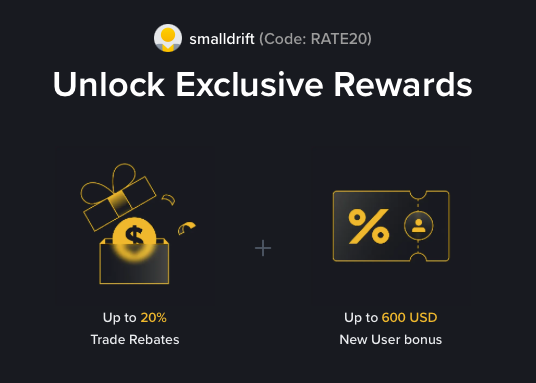
- Referral code: RATE20, pre-applied by this link
- Fee discount: 20%, shown on the Binance signup screen
- Additional rewards: Check Binance for current promotions and regional availability
Be wary of unofficial referral offers promising benefits they cannot show. The Binance signup screen lets you check the code and fee discount directly.
Compare Binance fees and available discounts →
SmallDrift may earn a commission when you sign up through this link. Trading involves risk, including loss of capital.
Related Articles



Explore Related Guides
Daily Crypto Market News
Follow Bitcoin price moves, major altcoins, and the events shaping the market.
Bitcoin ETF Flows Guide
Understand ETF inflows and outflows, and how to read them alongside price action.
Binance Fee Calculator
Learn how to estimate trading costs with referral and BNB discounts.
Verified Binance Referral Guide
See how RATE20 is applied and what to check on the Binance signup screen.