Bitcoin at $78K: The ETF Catch on November 4, 2026
Bitcoin rebounds to 78,018 USDT as ETF outflows slow but persist. The rolling high, altcoin breadth and Binance withdrawal recovery define the next test.

Bitcoin rebounded to 78,017.81 USDT while U.S. spot Bitcoin ETFs recorded another $115.6 million of net withdrawals. The price tape is improving; the institutional flow tape has merely become less bad. Whether this bounce can survive its first nearby resistance test matters more than the comforting shade of green on a trading screen.
Research cutoff: November 4, 2026, 07:02:25 UTC. Binance spot snapshots below were retrieved at 07:01:00–07:01:01 UTC; their rolling 24-hour windows end around 07:01 UTC on November 4 and start around 07:01 UTC on November 3. ETF figures refer to completed U.S. trading sessions, most recently November 3. Linked market pages show current data, which can differ from this article’s dated snapshot.
What is Bitcoin’s price telling us today?
BTC/USDT is recovering toward its rolling 24-hour high, but it has not cleared that reference point. The captured high was 78,164.00 USDT, just 146.19 USDT above the latest trade. That is roughly 0.19% away: close enough to test quickly, too close to treat as a generous cushion.
The same snapshot shows a low of 75,736.38 USDT and a volume-weighted average of 77,170.22 USDT. Bitcoin was about 1.10% above that weighted average and roughly 94% of the way from the rolling low to the rolling high. Buyers had recovered most of the observed range. They had not established what happens above it.
The distinction is useful because a positive 24-hour change is an observation, not a trading thesis. It tells you where the last trade sits relative to the window’s opening price. It does not tell you whether the next batch of offers will absorb the buying.
The market snapshot
These are Binance spot pairs quoted in USDT, not a consolidated dollar index. Quote volume measures turnover on each named pair during its rolling window; it is neither net capital inflow nor exchange-wide volume. The official Binance market overview provides a reader-readable place to follow current markets.
| Spot pair | Last price, USDT | Rolling 24h change | Rolling 24h low–high, USDT | Pair quote volume |
|---|---|---|---|---|
| BTC/USDT | 78,017.81 | +1.821% | 75,736.38–78,164.00 | 1.098 billion USDT |
| ETH/USDT | 2,298.65 | +2.259% | 2,226.44–2,309.00 | 440.10 million USDT |
| SOL/USDT | 93.01 | +1.495% | 89.86–93.93 | 160.41 million USDT |
| BNB/USDT | 701.14 | +1.207% | 680.74–703.30 | 89.43 million USDT |
ETH outperformed Bitcoin by about 0.44 percentage points; SOL and BNB lagged it. That is a selective rebound across this small sample, not evidence that every corner of crypto has joined a new advance. Four liquid assets are a useful dashboard. They are not the entire market.
CoinGecko’s separately retrieved global response put total capitalization at $2.636 trillion, down 0.98% over 24 hours, with $73.55 billion of reported volume and Bitcoin dominance of 59.35%. Its underlying update timestamp was 06:52:16 UTC. Those aggregate readings therefore use a different universe, methodology and update time from the Binance pair snapshots.
The CoinGecko global market charts can show newer or differently cached values. A green BTC pair and a red aggregate market are not automatically a data error. They are a reminder to identify what a number actually measures before building a narrative around it.
ETF selling slowed. It did not reverse.
The latest ETF session remained negative. On November 3, IBIT lost $95.0 million and Grayscale’s BTC fund lost $52.6 million. FBTC, BITB and MSBT together added $32.0 million, leaving the aggregate at negative $115.6 million.
The important comparison is the sequence rather than the newest number in isolation:
| U.S. trading session | Net spot Bitcoin ETF flow |
|---|---|
| October 30, 2026 | −$643.2 million |
| November 2, 2026 | −$398.6 million |
| November 3, 2026 | −$115.6 million |
| Three-session total, calculated | −$1,157.4 million |
These figures come from Farside Investors’ Bitcoin ETF flow table, which updates as reporting arrives and may be revised. The newest daily outflow was about 71% smaller than November 2’s. That is a reduction in selling pressure through this channel, not a return of net buying.
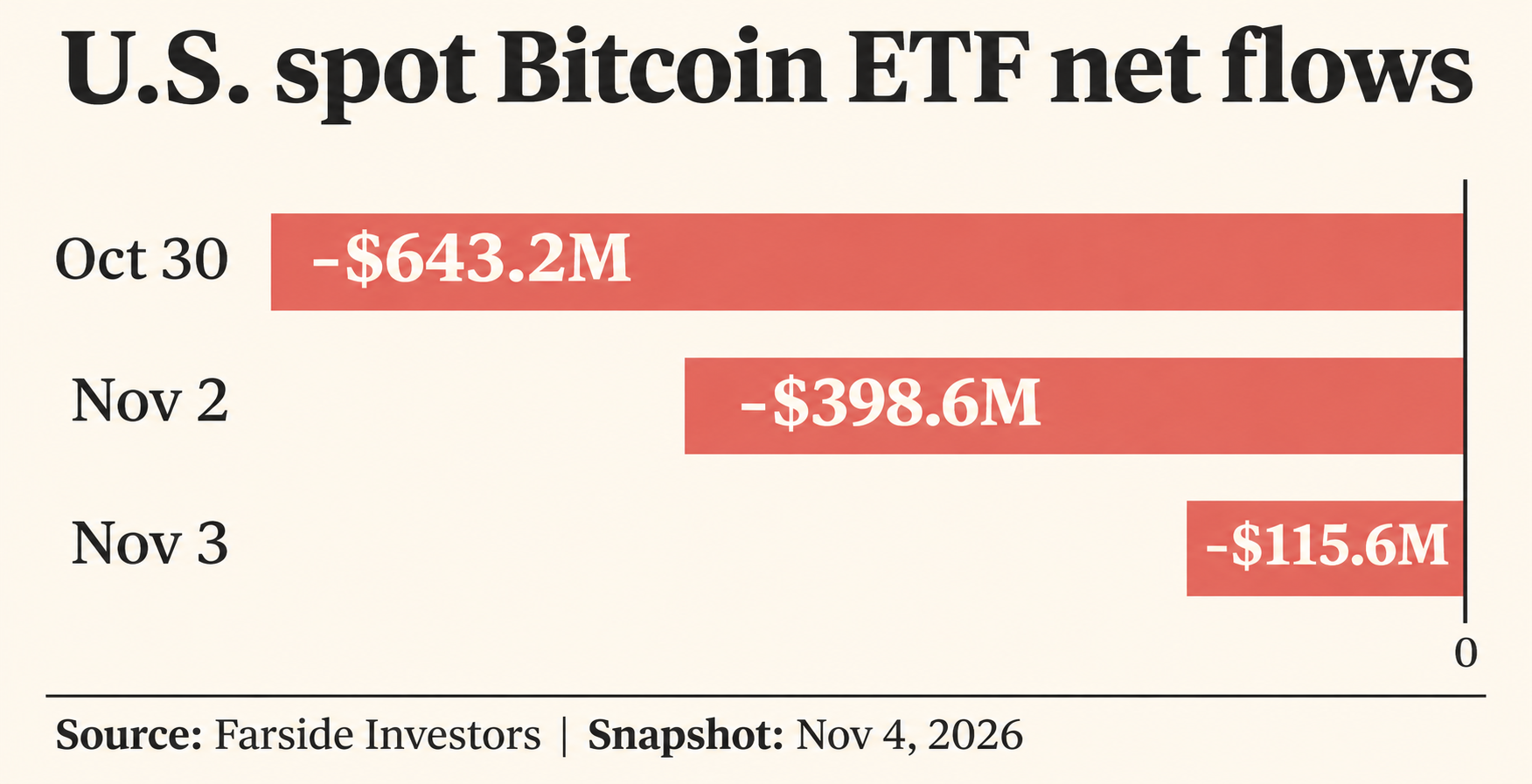
AI-generated infographic using the captured Farside figures; values are in U.S. dollars and rounded to one decimal million. Numeric labels are authoritative; bar lengths are illustrative.
A spot rebound alongside ETF redemptions has several possible explanations: demand elsewhere, less aggressive selling, or short covering. The snapshots do not identify which mechanism dominates. Calling the bounce “institutional accumulation” would go beyond the evidence.
ETF dollars also should not be divided by Binance pair turnover to announce that the selling was “easily absorbed.” One is net fund flow across a completed U.S. session; the other is gross trading activity on a single venue over a rolling window. The units look compatible. The economic meanings are not.
Three price references that make the rebound testable
The immediate test is 78,164 USDT; the nearby reference beneath price is the 77,170 USDT rolling weighted average. These are analytical reference points derived from the captured ticker, not independently established daily support and resistance zones.
| Reference | Why it matters | What would change the interpretation |
|---|---|---|
| 78,164 USDT | Captured rolling 24h high | Sustained trading above it would extend the observed recovery |
| 77,170 USDT | Captured rolling volume-weighted average, rounded | Losing it would put price back below the window’s average traded level |
| 75,736 USDT | Captured rolling 24h low, rounded | A fresh break below it would invalidate the recovery across this observed range |
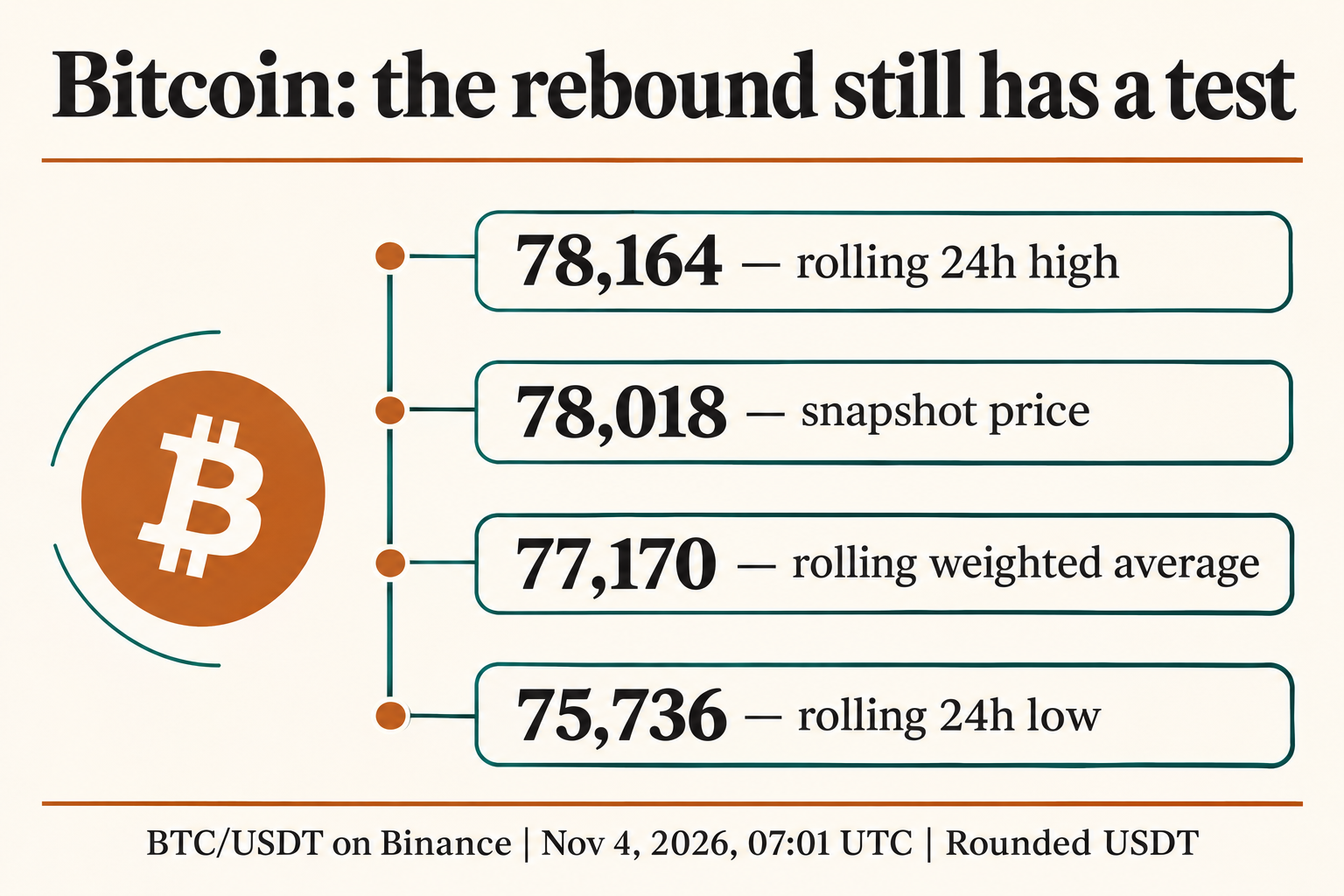
AI-generated schematic, not a historical price chart. Labels round the captured BTC/USDT values; spacing is illustrative.
The weighted average here is not an anchored VWAP from a chosen event, and it is not the average entry price of every market participant. As the 24-hour window advances, old trades roll out. Both the average and the high–low range can move without a dramatic new development.
For a stronger bullish case, look for price holding above the captured high after a retest, participation extending beyond one or two majors, and subsequent ETF sessions improving. For a weaker case, watch a rejection near that high followed by a return below the weighted average. Neither condition gives certainty; both make the thesis easier to falsify.
The market does not award extra points for sounding certain before the evidence arrives.
Binance’s recovery is a separate liquidity question
Binance’s November 3 notice describes a phased expansion of withdrawals after a security incident. It says reopening began at 04:00 UTC that day, with availability dependent on the particular asset and network. The official recovery announcement also warns of possible delays and directs users to confirm live withdrawal status.
That is progress reported by the exchange, rather than independent evidence of complete operational recovery. A quoted trading price cannot prove that a specific withdrawal route is available. Nor does the notice establish that every account or network has returned to normal.
This matters when comparing venue prices. Funds that cannot move freely can make apparent arbitrage opportunities harder to execute. Today’s research does not include synchronized cross-exchange order books or withdrawal tests, so it cannot quantify such a premium or claim one exists.
The same discipline applies to whale headlines. No verified, same-day wallet-cohort dataset was obtained for this article. A large transfer, even when authentic, could represent custody movement or internal exchange activity. It cannot substitute for evidence of fresh directional demand. The ETF data and ticker snapshots support a narrower, more defensible conclusion: the recovery is real within the observed price window, while its financing remains uncertain.
If you choose to use Binance, check access before execution
Confirm local eligibility and the live status of the asset-network combination you need before moving funds. A cheaper trade does not solve an unavailable transfer route.
Sign up on Binance with the RATE20 referral link →
The link pre-applies RATE20, advertised here for a 20% trading-fee discount. Review the actual referral benefit shown during registration; eligibility and product terms apply. This is an affiliate link, and SmallDrift may earn a commission.
Keep the fee arithmetic honest
Fees matter most when a narrow setup tempts you to trade repeatedly. Binance’s BNB fee explanation describes up to 25% off eligible spot and margin trading fees when BNB deduction is enabled and adequately funded. Futures have different terms; do not transplant the spot percentage onto a futures account.
The table illustrates a hypothetical 0.10% starting spot fee, with both a 25% BNB discount and a 20% referral benefit assumed eligible and applicable. It is an example, not a verified quote for your account.
| Illustrative fee treatment | Effective rate | Cost on 10,000 USDT of one-way turnover |
|---|---|---|
| Assumed starting fee | 0.100% | 10.00 USDT |
| After assumed 25% BNB deduction | 0.075% | 7.50 USDT |
| After both assumed benefits | 0.060% | 6.00 USDT |
The multiplication is 0.10% × 0.75 × 0.80 = 0.06%, a 40% reduction from the assumed starting fee. It is not a 45% reduction. Spreads, slippage, withdrawal charges and BNB price exposure remain separate costs. A limit order also does not guarantee maker treatment: a marketable limit can execute immediately as a taker.
For registration details, see Get 20% off with code RATE20. Verify the displayed terms before relying on any assumed savings.
Frequently asked questions
Why is Bitcoin rising despite ETF outflows on November 4, 2026?
The data show a rebound alongside ETF outflows, but do not establish its cause. ETFs are one demand channel; global spot and derivatives markets operate outside that channel and across different hours. Smaller redemptions can ease pressure without becoming net inflows.
What Bitcoin price levels matter in today’s snapshot?
The captured BTC/USDT references are 78,164 USDT above price, 77,170 USDT at the rolling weighted average and 75,736 USDT at the rolling low. They describe the window ending around 07:01 UTC, not permanent technical boundaries or guaranteed order-fill prices.
Are Binance withdrawals fully restored?
The reviewed notice describes a progressive reopening, not blanket availability. Check your exact asset and network in the live withdrawal interface. The article has not independently tested a withdrawal or audited the exchange’s recovery.
A more convincing market recovery would combine a sustained price extension, broader participation and a turn in reported ETF demand. At this cutoff, Bitcoin has delivered the bounce. The other evidence still has work to do.
Create a Binance account using RATE20 →
Referral code RATE20 is pre-applied. Confirm the displayed 20% trading-fee benefit and eligibility before registering; this affiliate link may compensate SmallDrift.
This article is for informational purposes only and does not constitute financial advice. Always do your own research before making investment decisions.
Get 20% Off Binance Trading Fees with RATE20
New to Binance? Open the official signup page with RATE20 already applied for a 20% trading-fee discount. You do not need to copy or type the code. Review the referral details before completing registration.
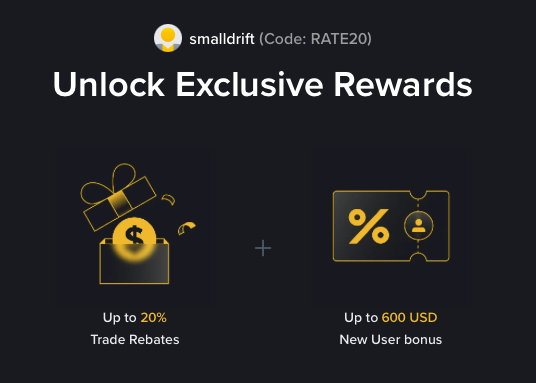
- Referral code: RATE20, pre-applied by this link
- Fee discount: 20%, shown on the Binance signup screen
- Additional rewards: Check Binance for current promotions and regional availability
Be wary of unofficial referral offers promising benefits they cannot show. The Binance signup screen lets you check the code and fee discount directly.
Compare Binance fees and available discounts →
SmallDrift may earn a commission when you sign up through this link. Trading involves risk, including loss of capital.
Related Articles


Explore Related Guides
Daily Crypto Market News
Follow Bitcoin price moves, major altcoins, and the events shaping the market.
Bitcoin ETF Flows Guide
Understand ETF inflows and outflows, and how to read them alongside price action.
Binance Fee Calculator
Learn how to estimate trading costs with referral and BNB discounts.
Verified Binance Referral Guide
See how RATE20 is applied and what to check on the Binance signup screen.