Bitcoin Holds $78K After Binance Shock — October 30, 2026
Bitcoin holds near $78,500 after Binance reports a $6.3 billion security incident. Track service restrictions, recovery evidence and ETF demand.
Bitcoin was still above $78,000 after Binance disclosed an estimated $6.3 billion security incident. That resilience sits beside a much less comfortable fact: a quoted price does not tell you whether you can move collateral when you need it. Today’s market question is whether a rebound in prices can survive a disruption in exchange access.
Research cutoff: October 30, 2026, at 07:02:46 UTC. Market figures below are historical snapshots retrieved at approximately 07:01:13 UTC. Linked market pages show current data and can differ from these figures. Rolling 24-hour changes are not calendar-day returns. Illustrations are AI-generated editorial concepts, not incident evidence or trading charts.
What did Binance actually confirm?
Binance estimated the incident’s total impact at about $6.3 billion and said roughly $3 billion of affected assets had been frozen. In its official security incident update, the exchange said deposits and withdrawals were temporarily suspended. It pledged to cover losses using SAFU and company funds and publish updated reserves after remediation.
The initial explanation involved a compromised engineer’s laptop and unauthorized withdrawal transactions. Binance said it had found no evidence of wallet private keys leaking. Those are company statements from an ongoing investigation, not an independent audit or a final technical account.
The important distinction is between impact, frozen funds and recoveries. Freezing an asset can prevent another transfer. It does not automatically return that asset to an exchange or settle an affected customer’s position. Subtracting $3 billion from $6.3 billion and calling the remainder the final loss would overstate what is known.
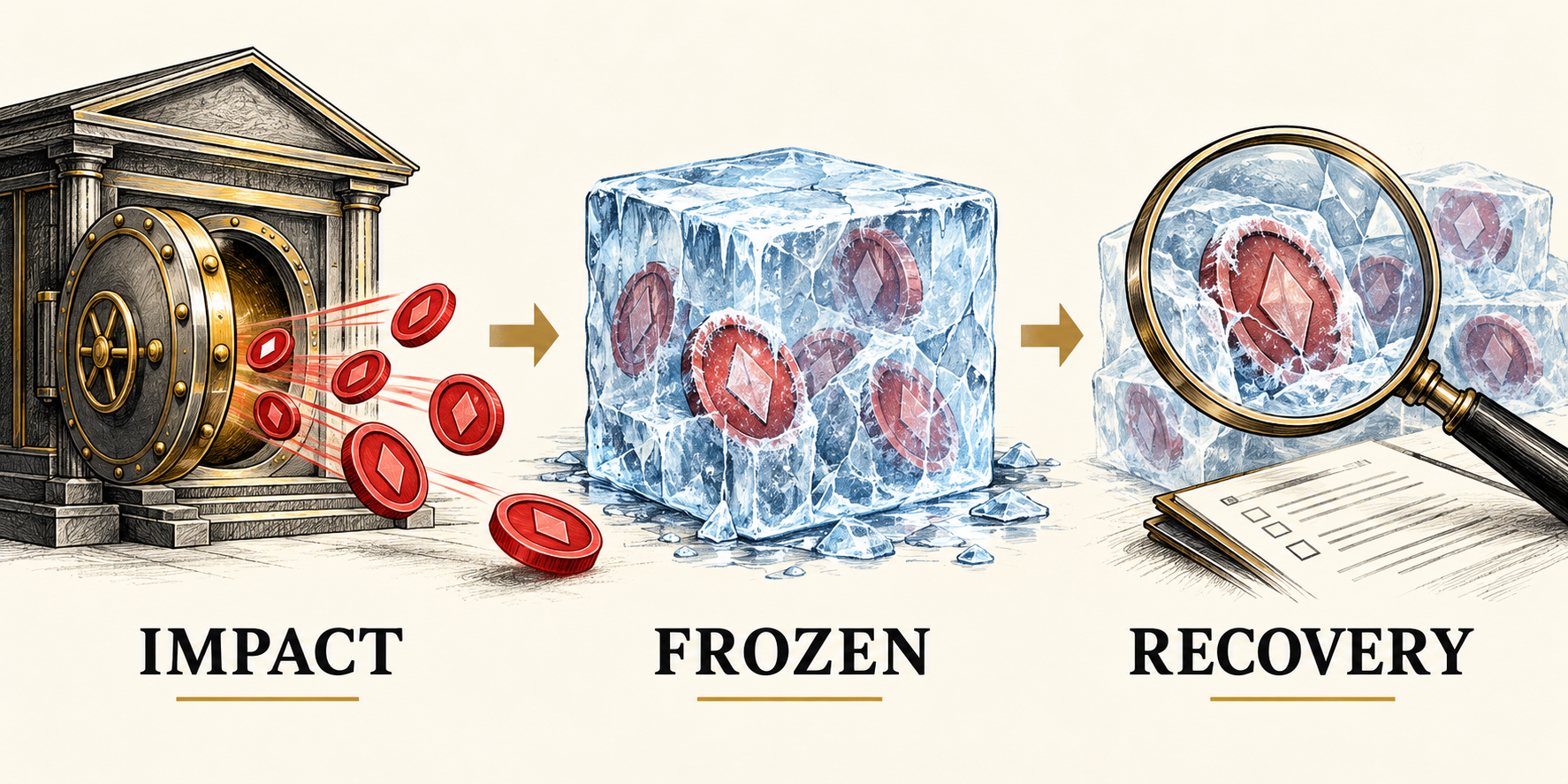
This distinction matters beyond accounting. Traders may respond differently to a large gross incident with substantial recoveries than to the same headline amount with no usable recovery path. Until there is a verified reconciliation, both the ultimate financial cost and the duration of operational disruption remain uncertain.
A promise to absorb losses also addresses a different question from immediate access. A customer can be protected from an eventual shortfall while still being unable to transfer funds during checks. Markets tend to discover that distinction at inconvenient times.
The market snapshot: Bitcoin holds up better than BNB
CoinGecko’s retrieved USD reference prices showed the following rolling 24-hour moves. These are aggregated dollar prices, not Binance USDT trading-pair quotes. The official CoinGecko market overview provides current comparisons across assets.
| Asset | USD reference price | Rolling 24-hour change |
|---|---|---|
| Bitcoin | $78,523.00 | -1.70% |
| Ethereum | $2,250.50 | -2.61% |
| BNB | $714.88 | -4.93% |
| Solana | $98.13 | -1.85% |
BNB underperformed Bitcoin by approximately 3.22 percentage points. That is consistent with investors assigning more risk to an exchange-linked token during an exchange incident. It does not prove who sold, whether selling was forced, or how much of the move came from this particular event.
Ethereum’s weaker return than Bitcoin also argues against treating the tape as a broad recovery. Solana was closer to Bitcoin’s decline, but a four-asset comparison is not a complete measure of market breadth. There is no reason to promote a small sample into an altcoin-season declaration.
A second CoinGecko response put total crypto capitalization at $2.656 trillion, down 4.13% over its rolling 24-hour window, with $142.45 billion of reported volume. Bitcoin dominance was 59.36%. These values belong to the saved API snapshot; the live global market charts returned different headline values during research. Provider refresh times and coverage can differ, so this article does not splice those readings into one supposedly synchronized series.
Higher reported turnover is not automatically fresh buying. Every executed sale has a buyer. Volume tells you that assets changed hands; it does not tell you that confidence improved or that an order book can absorb your next trade without substantial slippage.
Which Bitcoin levels matter now?
The practical reference points are the $76,500 area below and $80,000 above, rather than a precise prediction of the next candle. These are rounded monitoring zones, not statistically validated support and resistance signals.
The CoinGecko Bitcoin market page showed a 24-hour range of approximately $76,443 to $81,840 when opened during research. Its displayed price was already different from the earlier API retrieval. That is exactly why the observation time matters.
| Reference zone | Why it is on the watchlist | What would change the interpretation |
|---|---|---|
| Around $76,500 | Close to the observed intraday low | Repeated trading below it would weaken the rebound case |
| Around $78,500 | Near the saved aggregated USD price | Sustained trading here would show stabilization, not a completed recovery |
| $80,000 | Round-number checkpoint above the snapshot | A hold above it would improve the short-term recovery picture |
| Around $81,800 | Close to the observed 24-hour high | Reclaiming it would recover much of the observed range |
These references are useful because they make a thesis falsifiable. If a trader argues the shock has been absorbed, fresh lows would challenge that claim. If the argument is that panic is accelerating, sustained recovery through the upper range would challenge it instead.
Do not confuse those conditions with instructions to place orders at each number. A level is only one input. Available liquidity, venue reliability and position size can matter more when transfers are disrupted.
The same caution applies to cross-exchange prices. A premium can reflect limited arbitrage capacity rather than stronger underlying demand. When moving money between venues becomes harder, the price gap can persist longer than a leveraged trader can tolerate.
ETF demand is positive, but it is not a rescue package
The retrieved Farside Bitcoin ETF flow table showed a $17.2 million net inflow for October 29. Earlier search summaries showed conflicting totals, so the directly opened table takes precedence here. Automatically updated flow tables can still be revised.
| US trading session | Net spot Bitcoin ETF flow |
|---|---|
| October 26 | +$110.3 million |
| October 27 | +$176.0 million |
| October 28 | +$137.3 million |
| October 29 | +$17.2 million |
| Four-session sum | +$440.8 million |
The sequence indicates positive net fund demand across those four sessions, with a much smaller latest reading. It does not establish that institutions bought the incident-driven dip. Daily ETF totals do not contain the intraday timing needed to make that claim.
There is a second timing problem: this research cutoff precedes the October 30 US cash session. No completed October 30 ETF total exists in the observed table. Presenting Thursday’s flow as Friday’s institutional response would move the evidence forward by a day.
ETF demand can provide a separate route for Bitcoin exposure, but those flows do not reopen an exchange’s withdrawal system. Fund demand and operational recovery belong on separate lines of the checklist.

Watch transfers and verified updates before whale stories
No verified, incident-specific whale accumulation series was established in this research. Large transfers alone would not solve that gap: an exchange reshuffle, a freeze-related movement and a new investment can look similar without reliable address attribution.
The more useful sequence to monitor is concrete:
- A new official update identifying which services are available.
- Evidence that restored services operate consistently, rather than one isolated successful transfer.
- A technical account that narrows the suspected compromise and its scope.
- A reconciliation of affected, frozen and recovered assets.
- Reserve information that can be assessed alongside obligations and operational restrictions.
A reserve snapshot is informative, but it is not a complete statement of liabilities or an assurance that every withdrawal can be processed immediately. Readers should examine what the document actually measures before treating its publication as an all-clear.
There is also a communication risk. Incident updates create an opening for fake support accounts, recovery promises and urgent requests to connect wallets. Navigate to established official channels directly. An unsolicited message offering to rescue funds is not evidence that the sender has access to the recovery process.
Account planning after service status is clear
An account decision should follow a review of current service availability, custody arrangements and local eligibility. Registration itself does not resolve the incident or guarantee that deposits, withdrawals or a particular product are available.
For readers considering an account after that review, this is an affiliate link: Register on Binance with RATE20. Check the referral benefit displayed during signup and the terms applicable to your account; this article does not independently verify a universal discount entitlement.
The site’s separate guide explains the advertised offer: Get 20% off with code RATE20. Fees are worth understanding, but operational access comes first in today’s decision.
Three scenarios for the next market phase
A constructive scenario would combine stable service restoration, clearer loss accounting and Bitcoin holding above the lower observed range. That combination would reduce uncertainty on both the operational and price sides. A bounce on its own would provide much less information.
An intermediate scenario is a market that stabilizes while transfers remain restricted. Prices could look calmer without collateral mobility returning to normal. Traders who depend on moving funds quickly would still face a material constraint, even if the daily percentage change shrinks.
The adverse scenario would involve prolonged restrictions, a widening scope of affected systems or fresh lows across multiple assets. In that case, a small positive ETF reading would be weak evidence against the broader deterioration. Separate pools of demand can coexist with a stressed trading system.
These are conditional frameworks, not probability estimates. The research does not establish the likelihood of each outcome, and the incident remains capable of producing new information faster than a daily article can update.
Frequently asked questions
Why is Bitcoin falling on October 30, 2026?
The Binance security incident is a major contemporaneous risk catalyst, while Bitcoin’s saved USD reference price was down 1.70% over 24 hours. That timing supports watching the incident closely, but it does not isolate its causal contribution from other market forces.
Has Binance recovered the frozen $3 billion?
The official update said roughly $3 billion was frozen, which does not establish that it had been recovered. Final recoveries, financial losses and restoration of customer access require separate confirmation.
Did Bitcoin ETFs buy the selloff?
The observed table showed a $17.2 million October 29 inflow, but it did not establish purchases timed to the selloff. The research cutoff came before the October 30 US session, so Friday’s completed ETF response was unavailable.
For readers reviewing future account options, the Binance registration link pre-applies RATE20. This is an affiliate link; review current service notices and the displayed referral terms before proceeding.
This article is for informational purposes only and does not constitute financial advice. Always do your own research before making investment decisions.
Get 20% Off Binance Trading Fees with RATE20
New to Binance? Open the official signup page with RATE20 already applied for a 20% trading-fee discount. You do not need to copy or type the code. Review the referral details before completing registration.
- Referral code: RATE20, pre-applied by this link
- Fee discount: 20%, shown on the Binance signup screen
- Additional rewards: Check Binance for current promotions and regional availability
Be wary of unofficial referral offers promising benefits they cannot show. The Binance signup screen lets you check the code and fee discount directly.
Compare Binance fees and available discounts →
SmallDrift may earn a commission when you sign up through this link. Trading involves risk, including loss of capital.
Related Articles


Explore Related Guides
Daily Crypto Market News
Follow Bitcoin price moves, major altcoins, and the events shaping the market.
Bitcoin ETF Flows Guide
Understand ETF inflows and outflows, and how to read them alongside price action.
Binance Fee Calculator
Learn how to estimate trading costs with referral and BNB discounts.
Verified Binance Referral Guide
See how RATE20 is applied and what to check on the Binance signup screen.