Binance Fees Explained: Complete Breakdown for 2026
Understand Binance trading fees, withdrawal fees, and how to minimize costs with BNB discount and referral codes.

Spot Trading Fees
Binance charges a base rate of 0.10% for both maker and taker orders on spot trading. This is already among the lowest in the industry — Coinbase charges 0.40-0.60%, and Kraken charges 0.16-0.26%.
With a referral discount (code XVZGVYXX), this drops to 0.08% — a 20% reduction. If you also enable BNB fee payment (an additional 25% off), your effective spot trading fee falls to approximately 0.06% per trade.
To put this in real numbers: on a $10,000 trade, you'd pay $6 in fees with all discounts applied, compared to $10 at base rate or $40-60 on Coinbase. Over 100 trades, that's $600 saved versus no discounts and $3,400-5,400 saved versus Coinbase.
Futures Trading Fees
USDT-margined (USDT-M) perpetual futures charge 0.02% maker and 0.05% taker at the base level. Coin-margined (COIN-M) futures have the same fee structure. These are significantly lower than spot fees, which is one reason futures are so popular.
With a referral discount, futures fees drop to 0.016% maker and 0.04% taker. Using BNB for fee payment provides an additional 10% reduction on futures (note: the BNB discount is 25% for spot but only 10% for futures).
Futures traders should always use limit orders when possible. The difference between maker (0.016%) and taker (0.04%) fees is substantial — a taker order costs 2.5x more. On a $100,000 position with 10x leverage, maker fees cost $1.60 versus $4.00 for taker.
Important: futures also have funding rates — periodic payments exchanged between long and short holders every 8 hours. Funding rates are not fees paid to Binance, but they can add significant cost (or income) to your position depending on market conditions. During bullish periods, longs typically pay shorts, and vice versa.
Withdrawal Fees
Withdrawal fees vary by cryptocurrency and network. Here are common examples:
Bitcoin (BTC): 0.0000044 BTC on the Bitcoin network (~$0.31 at $70K). Lightning Network withdrawals are significantly cheaper. Ethereum (ETH): 0.00028 ETH on ERC-20 (~$0.55). USDT: 1 USDT on TRC-20 (Tron), 3.5 USDT on ERC-20 (Ethereum), 0.29 USDT on BSC (BEP-20), 1 USDT on SOL. BNB: 0.005 BNB on BEP-20 (~$3).
The key insight: always choose the cheapest network for withdrawals. For USDT, TRC-20 or BEP-20 saves you $2-3 per withdrawal compared to ERC-20. For large transfers, the percentage difference is small, but for frequent small withdrawals, it adds up.
Deposits are completely free on Binance — you only pay the sending network's gas fee. There are no deposit fees for crypto, and many fiat deposit methods (like SEPA in Europe) are also free.
Convert and OTC Fees
Binance Convert lets you swap between cryptocurrencies instantly without placing an order on the exchange. There's no explicit fee, but Binance applies a spread (the difference between buy and sell price). This spread typically ranges from 0.05% to 0.5% depending on the trading pair and market conditions.
For large trades ($10,000+), Binance's OTC (Over-The-Counter) desk offers competitive rates with tighter spreads. OTC trades don't impact the order book, so you avoid slippage on large orders.
P2P trading on Binance has zero trading fees. Binance doesn't charge buyers or sellers on its P2P marketplace. However, the prices set by P2P merchants may include a markup compared to the exchange rate.
Ready to get started?
VIP Tier System
Binance offers 10 VIP levels (Regular through VIP 9) based on 30-day trading volume and BNB holdings. Each tier progressively reduces trading fees.
Regular tier: 0.10% maker/taker (spot), 0.02%/0.05% (futures). VIP 1: Requires 1M USDT monthly volume OR 25 BNB — spot drops to 0.09%/0.10%, futures to 0.016%/0.04%. VIP 2: 5M USDT OR 100 BNB — spot 0.08%/0.10%, futures 0.014%/0.035%. VIP 3: 20M USDT OR 250 BNB — spot 0.07%/0.08%.
Higher VIP tiers (VIP 4-9) require progressively larger volumes and offer increasingly lower fees, eventually reaching 0.02%/0.04% for spot and negative maker fees (you get paid to provide liquidity) at the highest tiers.
VIP tier benefits stack with the referral discount and BNB fee payment. A VIP 1 trader with referral + BNB can achieve effective spot fees below 0.05%.
How to Stack All Discounts
The maximum fee reduction comes from combining all available discounts:
1. Referral code (XVZGVYXX): 20% off — applied at registration, permanent 2. BNB fee payment: 25% off spot, 10% off futures — enable in settings, hold BNB 3. VIP tier: Variable — increases with trading volume 4. Maker orders: Use limit orders instead of market orders
Example calculation for spot trading at Regular tier: Base fee 0.10% → Referral 20% off → 0.08% → BNB 25% off → 0.06%. For a VIP 1 trader: Base 0.09% → Referral → 0.072% → BNB → 0.054%.
For futures: Base taker 0.05% → Referral → 0.04% → BNB 10% off → 0.036%. Using maker orders: Base maker 0.02% → Referral → 0.016% → BNB → 0.0144%.
The bottom line: a regular trader using all discounts pays roughly 0.06% on spot and 0.014-0.036% on futures. This is 7-10x cheaper than Coinbase and 2-3x cheaper than most competitors.
Hidden Costs Most Traders Miss
Beyond explicit trading fees, several hidden costs affect your bottom line:
Slippage: The difference between your expected price and execution price. On illiquid pairs or large orders, slippage can cost more than fees. Binance's deep liquidity minimizes this, but always check the order book depth before placing large market orders.
Funding rates (futures): These 8-hourly payments can add 0.01-0.1% per session during volatile markets. Holding a leveraged long position during a bullish mania can cost 0.3% or more per day in funding alone.
Spread: The gap between the best bid and ask price. On major pairs (BTC/USDT, ETH/USDT), the spread on Binance is typically 0.01% or less. On low-liquidity altcoins, it can be 0.5% or more.
Conversion markup: Using Binance Convert or buying crypto with a credit card includes a spread or fee that may not be immediately visible. Always compare the offered rate against the exchange rate.
Binance Fees vs Competitors
How Binance stacks up against major competitors (base rates, before discounts):
Binance: Spot 0.10%/0.10%, Futures 0.02%/0.05%. Coinbase: Spot 0.40%/0.60%, Futures 0.04%/0.06%. Bybit: Spot 0.10%/0.10%, Futures 0.02%/0.055%. OKX: Spot 0.08%/0.10%, Futures 0.02%/0.05%. Kraken: Spot 0.16%/0.26%, Futures 0.02%/0.05%.
Binance ties or beats every competitor on base rates, and its referral + BNB discount combination makes it the cheapest option overall. The only exchange with comparable fees is OKX, but Binance's superior liquidity means less slippage — an invisible savings that's often larger than the fee difference itself.
For context: switching from Coinbase to Binance with referral saves approximately 80% on spot trading fees. On $100,000 monthly volume, that's roughly $680 saved per month.
Verify Before You Sign Up — Don't Get Scammed
Many sites advertise fake referral discounts that don't actually apply. Before signing up through any referral link, always verify the referral code and discount rate shown on the Binance registration page. Here's proof of our verified referral:
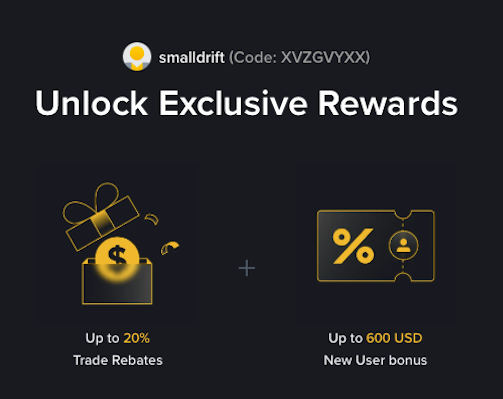
- Referral Code: XVZGVYXX
- Trade Rebate: Up to 20% on every trade (lifetime)
- New User Bonus: Up to 600 USD
If the registration page does not show these benefits, do not proceed. Only sign up when you can confirm the referral code and discount are applied.