Bitcoin Futures Hit 5x Spot Volume — Why Smart Money Trades Derivatives — India Guide
Bitcoin futures volume reaches 5.1x spot on Binance. Why institutions use leverage, hedging, and derivatives. Binance referral code RATE20 for 20% discount. Tailored for India traders with INR deposit methods.
For India Traders
This guide is tailored for traders in India. Sign up with referral code RATE20 for a 20% lifetime fee discount. Deposit INR easily using local payment methods: UPI, IMPS, Bank Transfer.
India has a 1% TDS on crypto transactions. P2P via UPI is the most popular way to buy USDT.
Bitcoin futures volume on Binance just hit 5.1 times spot trading volume — the highest ratio since mid-2023. Over $45 billion flows through Binance futures daily, while spot volume sits at a fraction of that. The derivatives market isn’t just bigger than spot anymore. It is the market. And if you’re only trading spot, you’re playing a smaller game than you think.
This isn’t degenerate gambling. Futures are how institutions hedge $57 billion positions, how miners lock in revenue months ahead, and how professional traders extract returns from a $71K Bitcoin that isn’t going anywhere fast. The post-FOMC sideways grind is a futures trader’s paradise — and most retail traders are sitting it out because they don’t understand the toolset.
Let’s fix that.
The Numbers: Futures Dominate Price Discovery
The futures-to-spot ratio on Binance reached 5.1 on March 10 — meaning for every $1 traded in spot BTC, $5.10 trades in futures. This isn’t a Binance anomaly. It’s the entire market.
| Metric | Value |
|---|---|
| Binance Futures 24h Volume | $45.8B |
| BTC/USDT Futures 24h Volume | $11.9B |
| Futures-to-Spot Ratio | 5.1x |
| Total Crypto Futures Daily Volume | $100B+ |
| Global Futures Open Interest | $180–200B |
| Binance Futures Open Interest | $24.2B |
When derivatives volume is five times spot, futures drive price discovery, not spot markets. The price you see on CoinGecko? It’s determined in the futures order book before it shows up in spot. Understanding this changes how you think about every trade.
CryptoQuant data confirms the shift: leveraged positions are setting the short-term direction while spot markets follow. The March 16 short squeeze — $113M liquidated in one hour — happened because futures positioning was extreme. Spot couldn’t have produced that move alone.
Why Futures Trading Has Real Advantages
Futures get a bad reputation from traders who use 100x leverage without a stop-loss and then tweet about it. But strip away the recklessness, and futures offer structural advantages that spot trading simply can’t match:
1. Profit in Both Directions
Spot traders can only go long. When BTC dropped from $74K to $70.9K after yesterday’s FOMC, spot holders watched their portfolio shrink. Futures traders who went short banked 4.2% — multiplied by whatever leverage they used.
In a market that’s been rangebound between $65K and $75K for months, the ability to short is the difference between making money and waiting for a breakout that may not come.
2. Capital Efficiency Through Leverage
This is the most misunderstood benefit. Leverage doesn’t mean recklessness — it means capital efficiency.
Consider: you want $10,000 of BTC exposure. In spot, you lock up $10,000. With 10x futures leverage, you lock up $1,000 — and the other $9,000 can earn yield in staking, lending, or sit as a reserve for other opportunities.
Institutions routinely use 2x–5x leverage not to gamble, but to free up capital. Strategy (formerly MicroStrategy) has 761,068 BTC on their books. Do you think their treasury management involves zero derivatives? Sophisticated players use futures to optimize every dollar.
| Leverage | Margin Required for $10K Position | Capital Freed | Liquidation Distance |
|---|---|---|---|
| 1x (Spot) | $10,000 | $0 | N/A |
| 2x | $5,000 | $5,000 | -50% |
| 5x | $2,000 | $8,000 | -20% |
| 10x | $1,000 | $9,000 | -10% |
| 20x | $500 | $9,500 | -5% |
The sweet spot for most traders is 3x–10x. Enough leverage to be capital-efficient, not so much that a normal pullback liquidates you.
3. Hedging: Protect Without Selling
This is where futures become genuinely powerful — and underappreciated.
Say you hold 1 BTC in cold storage. You believe in the long-term thesis, but the FOMC just turned hawkish and you expect a dip. Selling triggers a taxable event. Moving from cold storage takes time. Neither option is ideal.
Instead: open a 1 BTC short on futures. If BTC drops 5%, your spot position loses ~$3,500 — but your short gains ~$3,500. Net effect: zero. You’ve neutralized the risk without selling a single satoshi.
When the dip plays out, close the short and let your spot position ride. This is how miners hedge revenue, how funds manage drawdowns, and how anyone with significant holdings can sleep at night during FOMC weeks.
4. Isolated Risk: You Can’t Lose More Than Your Margin
On most crypto exchanges, futures losses are limited to your initial margin. Unlike traditional CME futures where a margin call can leave you owing money, crypto perpetual futures cap your downside at what you put in.
Got $500 in a position? The worst case is losing $500. Your other holdings, your savings, your cold wallet — untouched. This makes futures structurally safer than many people realize, as long as you size positions correctly.
Trade Bitcoin Futures With Lower Fees
Post-FOMC volatility creates ideal conditions for futures trading. Binance offers the deepest futures liquidity globally — $45.8B daily volume across 600+ pairs.
Sign up on Binance with 20% fee discount →
Use referral code RATE20 for a permanent 20% off all trading fees.
The Institutional Shift: $200B in Open Interest
If futures were purely a retail gambling product, institutions wouldn’t be piling in. But they are — at unprecedented scale.
CME Bitcoin futures now see record numbers of large reportable traders. SGX and Cboe have launched crypto derivatives. The CME is rolling out perpetual futures in 2026 — the first time the world’s largest derivatives exchange offers the same product that drives volume on Binance.
| Institutional Futures Signal | Detail |
|---|---|
| Global Futures Open Interest | $180–200B |
| CME Large Traders | Record breadth in 2025–2026 |
| CME Perpetual Futures | Launching 2026 |
| Institutional Allocation Plans | 71% plan to increase crypto exposure |
| Public Companies Holding BTC | 172+ (up 40% QoQ) |
| Corporate BTC Holdings | 1.7M+ BTC (8% of supply) |
The CLARITY Act — new U.S. legislation clarifying SEC and CFTC roles — has accelerated the trend. Goldman Sachs identified regulatory clarity as the primary catalyst for the next wave of institutional adoption. When Goldman’s derivatives desk is actively building crypto products, the smart move is understanding the same tools they use.
Europe’s MiCA II regulation has made leverage trading more transparent than ever, with mandatory disclosure of liquidation risks and standardized margin requirements. The days of unregulated 500x leverage on offshore exchanges are ending. What’s replacing them is a mature, institutional-grade derivatives market.
Post-FOMC: Why This Market Favors Futures Traders
Yesterday’s FOMC delivered exactly the kind of environment where futures outperform spot:
- BTC dropped 4.2% from $74K to $70.9K — pure profit for short sellers
- Range-bound action between $68K support and $75K resistance — perfect for range trading with longs at support and shorts at resistance
- $2.2 billion in USDT flowed into Binance — suggesting a bounce is coming, which futures traders can position for with defined risk
- Funding rates turned negative — meaning short sellers pay longs to hold positions. Getting paid to be long in a market that’s about to bounce? That’s the futures edge.
The 48-hour post-FOMC trough pattern suggests the dip completes today or tomorrow. A spot trader can only buy and hope. A futures trader can:
- Open a small long at $70K support with a stop at $68K
- Target $73K–$74K for a 4–5% move
- Use 5x leverage to turn that into 20–25% returns on margin
- Risk only the margin posted, not their entire portfolio
That’s not gambling. That’s structured risk management with asymmetric payoff.
Binance Futures Fees: How They Compare
Fees matter — especially for futures traders who execute frequently. Here’s how Binance stacks up against competitors:
| Exchange | Maker Fee | Taker Fee | Volume (24h) | Leverage |
|---|---|---|---|---|
| Binance | 0.02% | 0.04% | $45.8B | Up to 125x |
| MEXC | 0.00% | 0.02% | $8.2B | Up to 200x |
| Bitget | 0.02% | 0.06% | $12.1B | Up to 125x |
| Kraken | 0.02% | 0.05% | $3.4B | Up to 50x |
| KuCoin | 0.02% | 0.06% | $5.6B | Up to 100x |
Binance’s taker fee at 0.04% is lower than most competitors, and its liquidity — $45.8B daily — means slippage is virtually nonexistent on major pairs. When you’re trading with leverage, slippage matters more than the fee itself. A 0.1% slippage on a 10x position costs you 1% of your margin.
Maximize Your Futures Fee Savings
Stack your discounts on Binance:
- 20% off — Use referral code RATE20 at signup
- 25% off — Pay fees with BNB token
- Maker discount — Use limit orders for even lower futures fees
Effective fee: as low as ~0.06% per trade.
Start trading on Binance with maximum discount →
For the complete guide to maximizing savings, see Get 20% off with code RATE20.
Risk Management: The Non-Negotiable Rules
Futures are powerful. They’re also dangerous if used incorrectly. Here are the rules that separate traders from liquidation screenshots:
| Rule | Why It Matters |
|---|---|
| Never risk more than 1–2% of account per trade | Survive 50 losers in a row. You won’t need to — but you could. |
| Always use a stop-loss | Futures without stops = spot with extra steps to zero |
| Start with 3x–5x leverage | Learn the mechanics before touching 20x+ |
| Use isolated margin, not cross | Limits blast radius of a bad trade to one position |
| Don’t hold through major events without hedging | FOMC, CPI days are coin flips. Reduce exposure or hedge. |
| Track funding rates | Negative funding = you get paid to be long. Positive = you pay. |
The 2026 regulatory landscape helps here. The GENIUS Act and MiCA II require exchanges to display liquidation prices prominently, enforce maximum leverage limits by jurisdiction, and provide risk warnings. The era of someone accidentally opening 100x on their phone and getting liquidated in 30 seconds is ending.
The Bottom Line: Futures Are a Tool, Not a Casino
Five times more volume flows through Bitcoin futures than spot. $200 billion in open interest. CME launching perpetuals. Goldman building products. The institutional world has already decided: derivatives are the primary market for price discovery and risk management.
For retail traders, futures offer something spot can’t: the ability to profit in both directions, hedge existing holdings, and deploy capital efficiently. The post-FOMC environment — rangebound, volatile, with clear support and resistance — is exactly when these advantages matter most.
BTC is trading at $70,900 with the 48-hour post-FOMC trough window open. Whether you go long for the bounce, short the resistance, or hedge your spot bag — futures give you options that spot trading doesn’t.
The tool exists. The liquidity is there. The fees are lower than ever. The question is whether you’ll learn to use it.
What is Bitcoin futures trading?
Bitcoin futures trading involves contracts that track BTC’s price, allowing traders to profit from both rising and falling markets without owning the underlying asset. Perpetual futures — the dominant product on exchanges like Binance — never expire and use funding rates to stay aligned with spot prices. Daily global futures volume exceeds $100 billion, with Binance alone processing $45.8B.
How much leverage should beginners use for crypto futures?
Beginners should start with 3x–5x leverage and never risk more than 1–2% of their account on a single trade. While exchanges offer up to 125x leverage, professional traders and institutions typically use 2x–10x. Higher leverage means smaller price moves can liquidate your position — at 10x, a 10% adverse move results in total loss of margin.
What is the best Binance referral code?
The best Binance referral code is RATE20, giving you a permanent 20% discount on all trading fees. Combined with BNB fee payment (25% off), your effective fee drops to ~0.06% per trade.
Create your Binance account with 20% fee discount →
Referral code: RATE20 — permanent 20% off all trading fees.
This article is for informational purposes only and does not constitute financial advice. Always do your own research before making investment decisions.
How to Deposit INR on Binance
- Go to Trade → P2P on Binance
- Select Buy USDT with INR
- Choose a payment method:
- UPI
- IMPS
- Bank Transfer
- Select a verified merchant and complete the trade
- Use your USDT to trade any cryptocurrency on Binance
Verify Before You Sign Up — Don't Get Scammed
Many sites advertise fake referral discounts that don't actually apply. Before signing up through any referral link, always verify the referral code and discount rate shown on the Binance registration page. Here's proof of our verified referral:
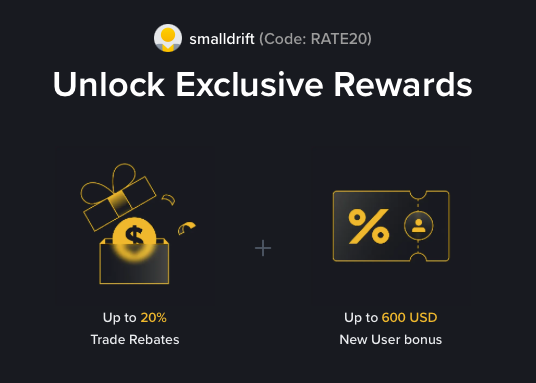
- Referral Code: RATE20
- Trade Rebate: Up to 20% on every trade (lifetime)
- New User Bonus: Up to 600 USD
If the registration page does not show these benefits, do not proceed. Only sign up when you can confirm the referral code and discount are applied.