Bitcoin Reclaims $60K: Is It Enough? November 26, 2026
Bitcoin rebounds to $60,601, but seven sessions of ETF outflows and a Thanksgiving trading pause leave the recovery facing a fresh demand test.

Bitcoin has reclaimed $60,000, but US spot Bitcoin ETFs just recorded another $453 million of net outflows. The price bounce is real; evidence that fund demand has turned is still missing. With Wall Street closed for Thanksgiving, traders now face a recovery that must find its footing while a major institutional trading channel takes a day off.
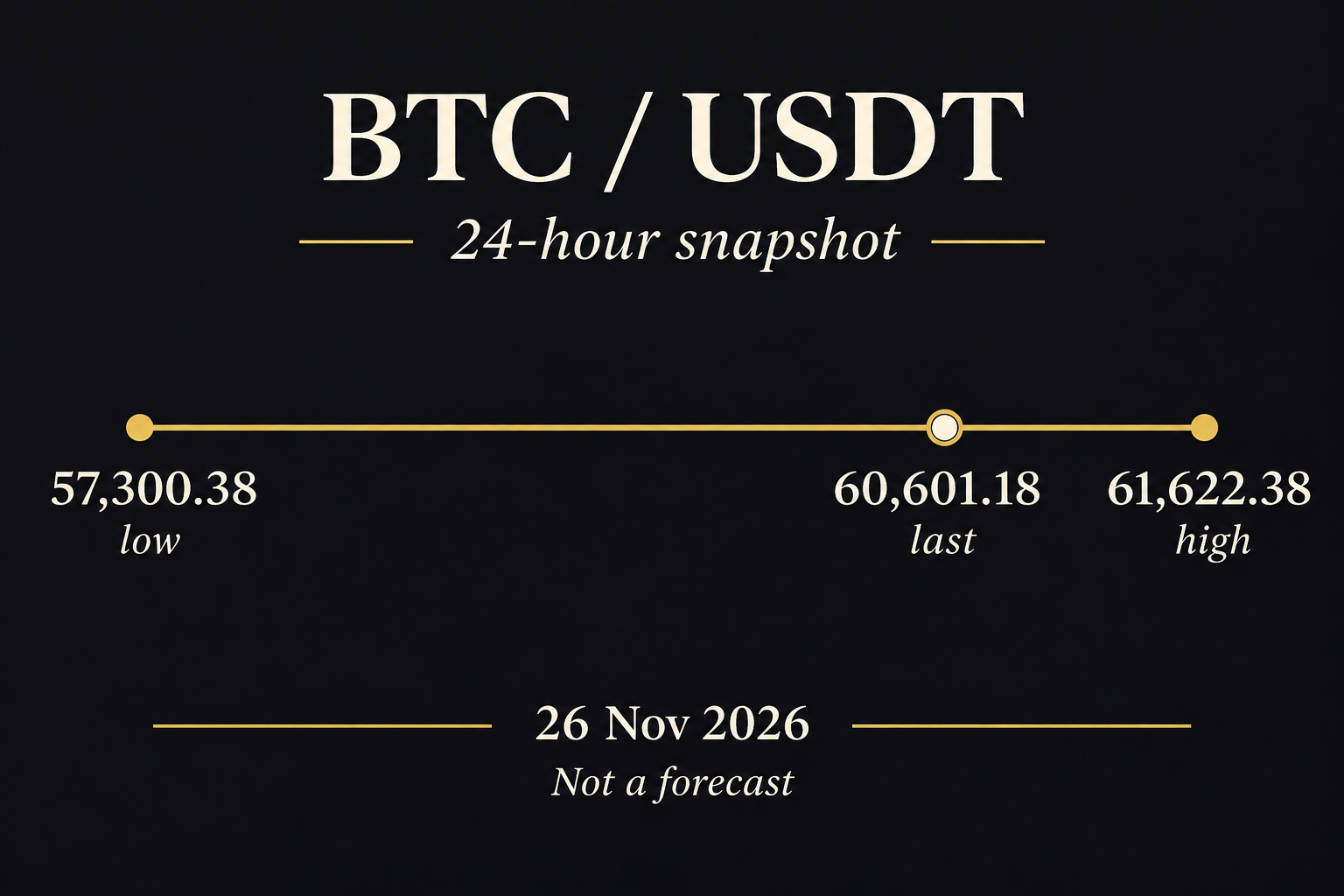
Research cutoff: November 26, 2026, 07:02:29 UTC. Prices below are Binance spot USDT-pair snapshots retrieved around 07:01 UTC, with rolling 24-hour windows ending around 07:01:32 UTC. ETF figures refer to completed US trading sessions through November 25. Linked market pages show current data and can differ from this historical snapshot. The CoinGecko API and rendered market page returned different totals during research; the global figures below explicitly use the saved API response. Images are original AI-generated editorial illustrations; the range graphic summarizes the snapshot and does not reconstruct a historical price path.
What does Bitcoin’s $60,601 rebound actually prove?
It proves buyers have lifted BTC from its rolling low, but it does not establish a durable trend reversal. Binance BTC/USDT stood at 60,601.18 USDT, a 2.377% gain over its rolling 24-hour window. The same window included a low of 57,300.38 and a high of 61,622.38.
That is a meaningful recovery. It is also a wide trading range: approximately 4,322 USDT from bottom to top. A market capable of moving across that distance can make a modestly profitable position look very temporary.
Here is the exchange-specific snapshot behind the analysis. USDT is the quote asset; these are not a consolidated dollar index or calendar-day closing prices. The official Binance market overview lets readers check the live market after publication.
| Binance spot pair | Last price, USDT | Rolling 24h change | Rolling low | Rolling high | Rolling quote volume |
|---|---|---|---|---|---|
| BTC/USDT | 60,601.18 | +2.377% | 57,300.38 | 61,622.38 | 1.695 billion USDT |
| ETH/USDT | 1,689.09 | +1.820% | 1,608.86 | 1,730.00 | 691.8 million USDT |
| SOL/USDT | 70.78 | +2.953% | 65.84 | 71.95 | 222.0 million USDT |
Bitcoin was roughly 5.76% above its rolling low, yet about 1.66% below its high. Those distances describe where the snapshot sits inside the observed range. They do not tell us the order in which every trade occurred, how often either boundary was tested, or who bought the rebound.
That last distinction matters. A rising price is consistent with fresh spot demand, short covering, or a combination of both. This research does not include a verified derivatives positioning series that would separate those explanations. Calling it institutional accumulation would turn an observation into a story without the missing evidence.
ETF redemptions remain the unresolved demand problem
The latest Farside Investors Bitcoin ETF table showed net outflows of $453.0 million on November 25, following $231.4 million on November 24. That extends the negative run to seven consecutive trading sessions, from November 17 through November 25.
The newest daily withdrawal was larger than the preceding session’s. There is no evidence of a positive flow turn in that latest row. Reports discussing only the earlier six-session streak are using an older observation.
Fund flows and price measure different things. Daily ETF subscriptions and redemptions describe one investment channel. Bitcoin trades globally, around the clock, across venues and instruments. A rally alongside redemptions is possible because marginal buying elsewhere can outweigh selling at a particular moment.
The analytical mistake is to assume that this possibility means the funding problem has disappeared. A rebound can absorb supply for a session without establishing a replenished pool of patient buyers. The next useful test is whether fund demand improves when normal US trading resumes, and whether price holds up while that information arrives.
Nor should a net outflow be translated mechanically into an identical amount of immediate exchange selling. Creation and redemption arrangements, intermediary inventories and timing complicate that relationship. The directional message is weaker demand through the funds; the exact execution footprint requires additional evidence.
Why Thanksgiving changes the confirmation test
The NYSE holiday calendar identifies November 26 as the Thanksgiving closure and November 27 as an early-close session, with the core market closing at 1 p.m. Eastern Time. Bitcoin itself keeps trading.
This produces a practical information gap. A Thursday price rally cannot be accompanied by a normal Thursday US ETF trading session. An absent holiday flow observation must not be read as zero redemptions, renewed inflows, or a clean bill of health for institutional demand.
Friday brings another complication: a shortened US session gives investors less ordinary exchange trading time before the weekend. That does not guarantee a particular price move. It does mean a single holiday-period candle deserves less confidence than a recovery that survives broader participation and subsequent flow reports.
Thin liquidity is a risk to monitor, rather than a measured fact established by this snapshot. A 24-hour turnover total does not reveal available order-book depth at the time you place an order. A market can print substantial daily volume and still offer poor execution for a large order at a particular instant.
The calendar is closed. The risk engine did not get the memo.

Which Bitcoin levels matter next?
The immediate reference points are 60,000, the observed 61,622 high, and the 59,194 rolling opening price. These are scenario markers derived from this snapshot, rather than independently established multiweek support and resistance zones.
| Reference, BTC/USDT | Why it matters | What would strengthen the interpretation |
|---|---|---|
| 61,622.38 | Observed rolling 24h high | Sustained trading above it, followed by a successful retest |
| 60,000 | Round-number checkpoint | Repeated holds after pullbacks rather than a brief reclaim |
| 59,194.01 | Rolling window opening price | Staying above it preserves the snapshot’s positive window return |
| 57,300.38 | Observed rolling 24h low | A break would undercut the range-based recovery thesis |
A constructive scenario begins with Bitcoin holding the round number and eventually accepting prices above the observed high. “Accepting” means more than a quick wick: buyers must continue transacting there without an immediate collapse back into the range.
A less convincing scenario is a sideways drift between 60,000 and the high while ETF confirmation remains unavailable. That could be consolidation, but the evidence would still be incomplete. Patience has a better information budget than a market order placed out of boredom.
The defensive scenario begins with a failure to hold 60,000, followed by a move back through the rolling opening reference. That would weaken the near-term recovery, though it would not automatically imply a retest of the low. These checkpoints organize observation; they are not instructions to enter a leveraged position at every line.
Put execution ahead of the headline
If you choose to trade this setup, decide your maximum acceptable loss and check the spread before choosing order size. Limit orders provide price control but may remain unfilled; market orders prioritize execution while leaving the final price uncertain.
Create a Binance account with RATE20 →
This is a referral link and may compensate SmallDrift. Check the displayed referral benefit, regional eligibility and account terms during signup. Our guide explains the offer: Get 20% off with code RATE20. A fee benefit does not protect a position against a move through its risk limit.
Altcoins are participating, but leadership is mixed
SOL/USDT’s 2.953% rolling gain exceeded Bitcoin’s 2.377%, while ETH/USDT’s 1.820% lagged. That is participation across these three pairs, not proof of a market-wide altcoin rotation.
Relative performance is especially easy to overread after a sharp selloff. A token that bounces faster may simply have a different volatility profile. To establish sustained leadership, you would want repeated relative strength across several observations and an understanding of the volume supporting it.
The saved CoinGecko global API snapshot put aggregate capitalization at $2.100 trillion, down 0.672% over 24 hours, with Bitcoin dominance around 57.90%. Its reader-facing global charts displayed different totals during research. We have retained the retrieved API values rather than blending the two responses into a synthetic number.
An exchange pair can rise while an aggregate market measure falls: coverage, update timing and the assets included differ. That mismatch is a reason to label sources carefully, not a reason to force every dashboard into the same narrative. The safer conclusion is limited: the three sampled Binance pairs were positive, while the saved global API measure was negative.
Binance’s network notice is an execution detail worth checking
Binance’s Tron wallet maintenance notice scheduled maintenance for 06:00 UTC on November 26, with network deposits and withdrawals suspended from 05:55 UTC until completion. The accessible announcement excerpt did not establish a confirmed reopening time.
If your trading plan requires moving funds over Tron, verify the current network status before initiating a transfer. A network maintenance notice concerns transfer availability; it does not, by itself, establish an interruption in Bitcoin spot trading or explain the market rebound.
This distinction is practical. The price you want and the funds you can actually move are separate constraints. Check the asset, destination network and live deposit or withdrawal status before relying on a transfer to fund a time-sensitive trade.
Keep fee assumptions separate from market conviction
A discount is useful only after the trade itself makes sense. The cost to compare is the full execution bill: commission, spread, slippage and, where relevant, funding. A lower commission can be overwhelmed by a poor fill during a fast move.
Referral benefits and BNB payment discounts depend on the product, account and current terms. We have not verified a universal stacking rate for every reader, so this market report does not promise a specific effective commission or treat all limit orders as eligible for maker pricing. A limit order that immediately crosses the spread can execute as a taker.
Review Binance signup with referral code RATE20 →
The link pre-applies RATE20. Confirm the benefit shown at registration and review your actual fee schedule before trading. Keeping fees small is sensible; increasing turnover just to use a discount is an expensive interpretation of savings.
Frequently asked questions
Why is Bitcoin above $60,000 if ETFs are seeing outflows?
ETF demand is only one part of the global Bitcoin market. Buying elsewhere or short covering can support price while funds record redemptions. This snapshot establishes the price recovery and the latest negative fund flow, but does not identify the buyers responsible for the bounce.
Are there US Bitcoin ETF flows on Thanksgiving 2026?
November 26 is a US exchange holiday, so there is no normal ETF trading session to evaluate. Missing holiday observations are not equivalent to a reported zero-flow session. The latest completed session in this research is November 25, and Friday’s session is shortened.
What would make the Bitcoin rebound more convincing?
Holding 60,000, sustaining a move above the observed 61,622.38 high, and seeing fund demand improve would strengthen the case. These are separate tests. A breakout alone cannot establish renewed institutional buying, and one positive future flow report would not guarantee lasting price support.
This article is for informational purposes only and does not constitute financial advice. Always do your own research before making investment decisions.
Get 20% Off Binance Trading Fees with RATE20
New to Binance? Open the official signup page with RATE20 already applied for a 20% trading-fee discount. You do not need to copy or type the code. Review the referral details before completing registration.
- Referral code: RATE20, pre-applied by this link
- Fee discount: 20%, shown on the Binance signup screen
- Additional rewards: Check Binance for current promotions and regional availability
Be wary of unofficial referral offers promising benefits they cannot show. The Binance signup screen lets you check the code and fee discount directly.
Compare Binance fees and available discounts →
SmallDrift may earn a commission when you sign up through this link. Trading involves risk, including loss of capital.
Related Articles


Explore Related Guides
Daily Crypto Market News
Follow Bitcoin price moves, major altcoins, and the events shaping the market.
Bitcoin ETF Flows Guide
Understand ETF inflows and outflows, and how to read them alongside price action.
Binance Fee Calculator
Learn how to estimate trading costs with referral and BNB discounts.
Verified Binance Referral Guide
See how RATE20 is applied and what to check on the Binance signup screen.