Bitcoin Below $65K: The Demand Test — November 17, 2026
Bitcoin trades below $65,000 as ETF reports remain incomplete. Here are the price levels and demand signals that would make a recovery more convincing.
Bitcoin is below 65,000 USDT while Solana is gaining more than 2%, an awkward combination for anyone declaring a clean market recovery. The latest ETF table still has a missing report from its largest fund, so the apparent improvement in institutional selling is not a finished result. Today’s useful question is whether buyers can reclaim resistance while complete fund reports confirm that demand is returning.
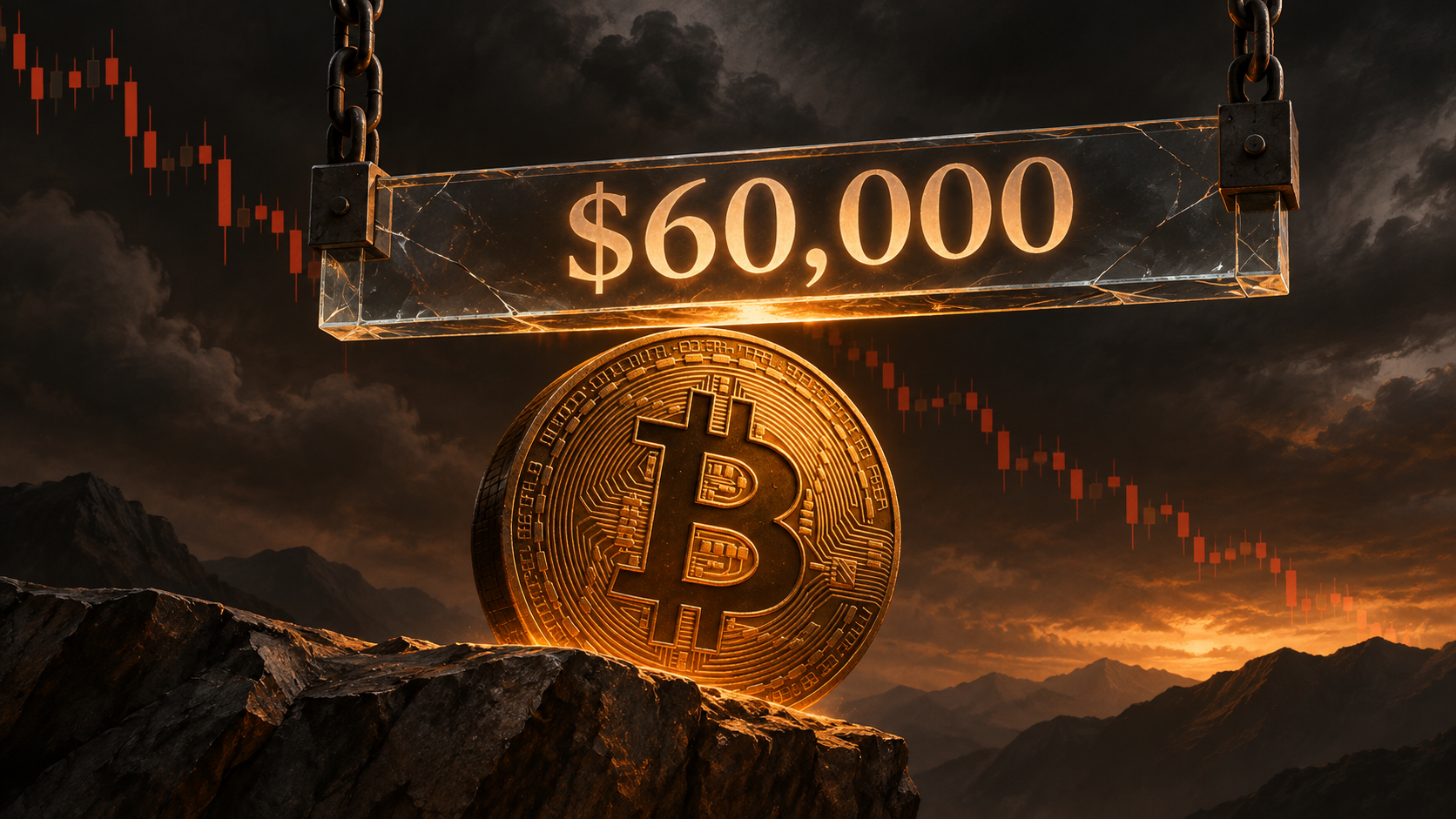
Research cutoff: November 17, 2026, 07:02:38 UTC. Binance spot snapshots were retrieved around 07:01:23–07:01:25 UTC; each covers its own rolling 24-hour window ending around 07:01:24 UTC. ETF figures refer to US trading sessions, with November 16 explicitly incomplete. Linked market pages show current data; the figures below are a historical research snapshot. Images are original AI-generated editorial illustrations and conceptual diagrams, not trading charts or documentary evidence.
What is Bitcoin’s price on November 17?
BTC/USDT was 64,598.96 USDT on Binance, down 0.271% over its rolling 24 hours. That is a specific exchange pair quoted in a stablecoin, not a universal dollar closing price. The distinction matters when comparing this table with consolidated market pages or another venue’s daily candle.
The observed range was 63,905.01–65,696.16 USDT. Bitcoin was roughly 694 USDT above its rolling low and 1,097 USDT below its high: about 39% of the way up that range. There is room for a bounce without evidence that the range has broken upward.
| Binance spot pair | Last price, USDT | Rolling 24h change | Rolling low–high, USDT |
|---|---|---|---|
| BTC/USDT | 64,598.96 | -0.271% | 63,905.01–65,696.16 |
| ETH/USDT | 1,828.28 | +0.572% | 1,787.11–1,866.89 |
| SOL/USDT | 72.82 | +2.204% | 69.93–73.30 |
| BNB/USDT | 593.39 | +0.176% | 583.81–597.91 |
Use the official Binance market overview for reader-readable live market context. Its aggregated display and later updates need not reproduce these pair-specific snapshots. BTC/USDT recorded approximately 1.507 billion USDT in quote turnover during the sampled window. Turnover measures trading activity; every completed trade has a buyer and a seller, so it is not equivalent to fresh money entering Bitcoin.
That last distinction is easy to forget in a recovery. Busy trading can mean accumulation, distribution, or the same capital changing hands repeatedly. A stronger interpretation needs evidence beyond volume alone.
Has the ETF selling stopped?
The available November 16 table does not establish that selling has stopped. Farside Investors’ Bitcoin ETF flow table showed a negative $68.6 million subtotal for Monday, but IBIT was still marked with a dash. That entry is missing data, not a reported zero.
For completed sessions, November 12 showed net outflows of $284.1 million and November 13 showed $185.4 million. Friday was less negative than Thursday. Monday cannot yet extend that comparison on a like-for-like basis.
| US session | Net flow shown, USD millions | How to read it |
|---|---|---|
| November 12 | -284.1 | Completed row in retrieved table |
| November 13 | -185.4 | Completed row in retrieved table |
| November 16 | -68.6 | Provisional subtotal; IBIT missing |
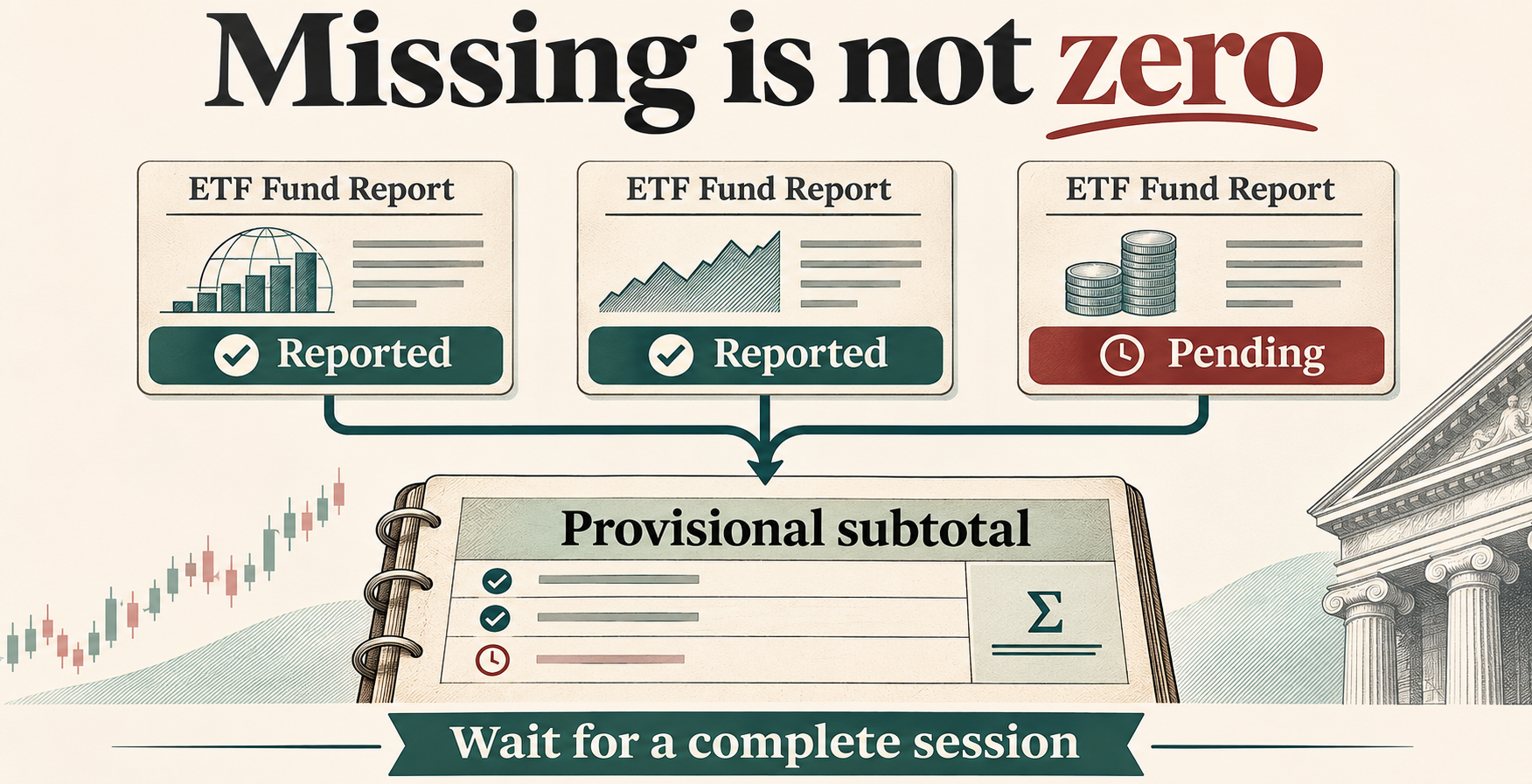
The missing observation could change the total in either direction. Even a final number that looks better than Friday would establish only a reduction in net selling for one session. A sustained return of subscriptions would be stronger evidence of renewed demand.
There is also a timing problem. ETF flows describe a completed US session, while crypto trades continuously. An overnight bounce can happen before the next set of fund figures exists. Treating the two as simultaneous measurements gives a tidy narrative at the expense of accuracy. Markets already supply enough fiction without help from a spreadsheet.
Why macro still matters to the rebound
In its November 16 market update, Wintermute framed the recent weakness around higher rate expectations and highlighted the roughly $68,000 area around Bitcoin’s 200-week average. The desk also interpreted the rebound as potentially driven by short covering rather than convincing new allocations. Those are the desk’s assessments, not conclusions established by today’s ticker alone.
The economic mechanism is straightforward: higher expected cash yields raise the opportunity cost of holding an asset without contractual income. That does not mechanically force Bitcoin lower, but it can make investors demand a more attractive entry price or reduce exposure across speculative assets.
The reverse is equally conditional. A softer policy outlook might help risk appetite, but a favorable headline does not guarantee that ETF investors or spot buyers add exposure. A macro catalyst changes the backdrop; executed purchases change the market.
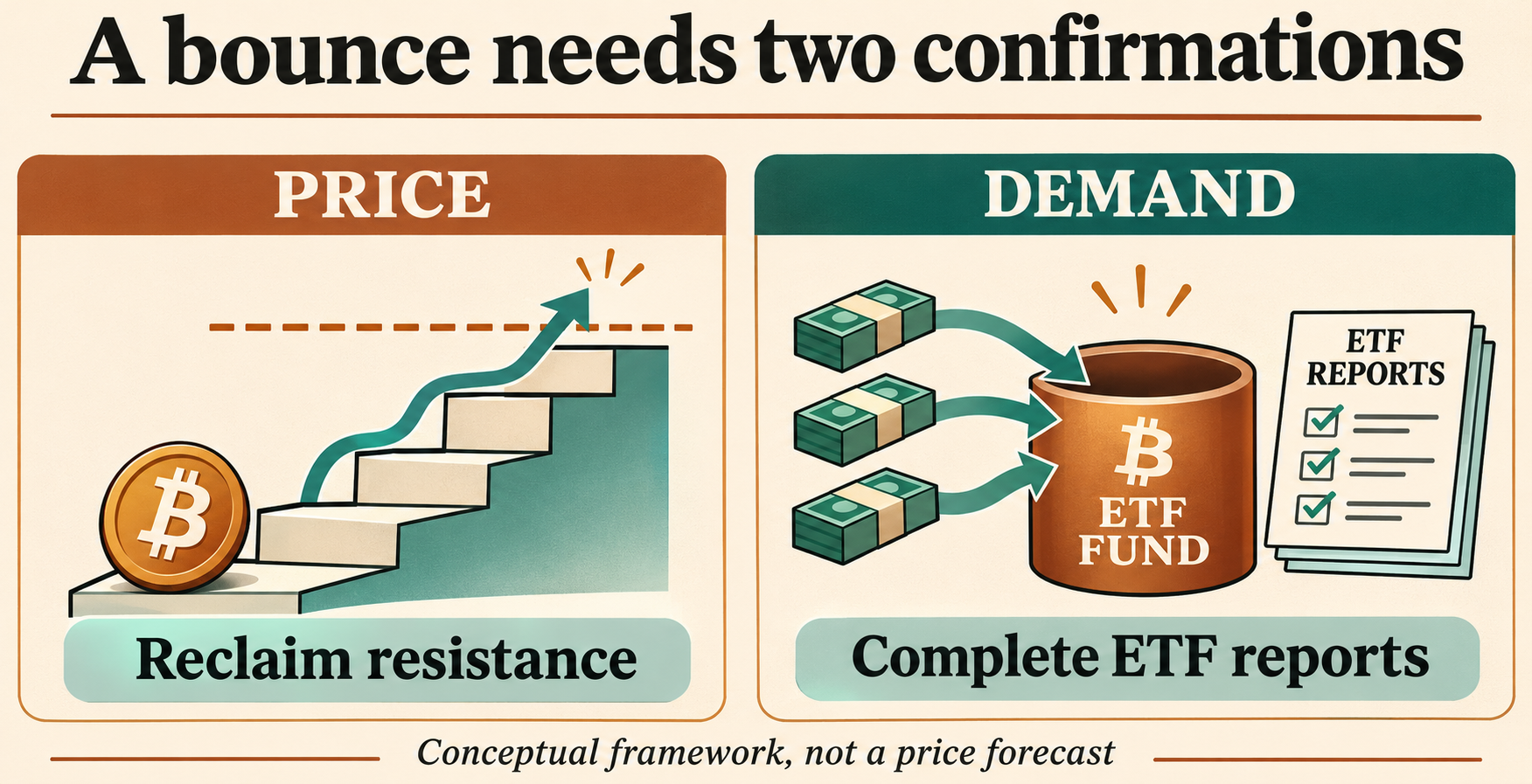
For this article’s decision framework, the strongest recovery would combine improving price structure with independently observable demand. A price bounce without subscriptions remains vulnerable to fading positioning effects. Positive subscriptions without price progress could mean other sellers are absorbing the buying. Neither observation should be discarded simply because it complicates the preferred story.
Which Bitcoin levels matter now?
The immediate reference points are the observed 63,905 low and 65,696 high; $68,000 is a broader research reference. The first two come directly from the Binance rolling window. They are temporary market landmarks, not statistically validated support and resistance zones.
| Reference | Basis | Conditional interpretation |
|---|---|---|
| 63,905 USDT | Sampled rolling low | Losing it would weaken the short-term rebound case |
| 65,000 USDT | Round-number checkpoint | Reclaiming it alone would still leave the rolling high overhead |
| 65,696 USDT | Sampled rolling high | Holding above it would improve the immediate structure |
| About $68,000 | Wintermute’s longer-term reference | A broader reclaim would need confirmation beyond one intraday move |
An intraday trade above resistance and an accepted move above it are different observations. One possible confirmation rule is to wait for a daily close above a selected level and then assess whether a subsequent retest holds. That is an example of a consistent process, not a claim that this rule has a proven edge in the current market.
The calculation also matters for risk. From the sampled last price, the rolling high is approximately 1.70% higher and the low about 1.07% lower. Those distances exclude execution costs and do not define a complete trade: a trader still needs a time horizon, an invalidation rule, and position sizing.
Does Solana’s strength mean altcoin season?
A 2.204% rolling gain in SOL/USDT is relative strength in this sample, not evidence of a broad altcoin regime. Ether and BNB were positive too, but their gains were smaller. Four liquid pairs cannot stand in for the entire market.
CoinGecko’s separately retrieved global snapshot put total crypto capitalization near $2.220 trillion, with a rolling 24-hour change of approximately -1.06% and Bitcoin dominance around 58.43%. Its official global market charts provide the reader-facing context. The live page showed different figures during research, so these observations should not be combined as if they were synchronized measurements.
That discrepancy is a reason to preserve timestamps and source definitions. Aggregators can use different constituent sets, update schedules, and pricing methods. The Binance pair returns above are a cleaner comparison within one venue and nearly the same retrieval period; global capitalization answers a different question.
The practical reading is selective participation. To argue for a broader rotation, look for strength across more assets and longer intervals, rather than promoting the day’s strongest large-cap token into a market-wide signal. A green leaderboard can coexist with a weak underlying tape.
Binance news: frozen assets are not new buying power
The relevant exchange backdrop remains the October theft. The US Justice Department’s November 12 announcement described court authorization to seize or restrain more than $1.2 billion in cryptocurrency stolen from Binance, within more than $2.7 billion frozen through combined efforts. Those are overlapping amounts, not two piles to add together.
A freeze, legal restraint, recovery, and eventual return of assets are separate stages. The announcement does not prove that customers received those funds or that an equivalent amount became available to buy Bitcoin. It is relevant to confidence and custody risk; it is not an ETF inflow.
The same caution applies to whale narratives. This research does not establish a verified aggregate whale-accumulation figure. A large wallet transfer alone cannot tell you whether its owner bought, sold, moved collateral, or reorganized custody. Without reliable address attribution and a defined measurement window, there is no defensible whale-demand number to insert here.
Before placing an order
If you choose to use Binance, check regional eligibility, the relevant asset’s deposit and withdrawal availability, and the account’s displayed terms before funding it. Today’s market snapshot cannot verify those account-specific conditions.
Register on Binance with referral code RATE20 →
The link pre-applies RATE20. Review the displayed referral benefit before registration; this article does not independently verify a universal discount for every region and product. SmallDrift may earn a referral commission. The site’s Get 20% off with code RATE20 guide explains the advertised offer and checks to make before signing up.
Costs deserve attention when the available range is tight. Compare the actual fee tier, spread, order size, and likely slippage. A limit order can control the worst acceptable execution price, but it may not fill; a marketable limit order can still incur taker fees. No universal fee-stacking calculation is assumed here.
FAQ
Is Bitcoin back above $65,000 on November 17, 2026?
Not in this snapshot: Binance BTC/USDT was 64,598.96 USDT. Its rolling high was above 65,000, but that does not make the sampled last price a sustained reclaim. Check the live market page for subsequent trading.
Did Bitcoin ETFs have only $68.6 million of outflows on Monday?
That was a provisional subtotal, not a complete final result. IBIT was missing from the retrieved November 16 row. Missing entries must not be silently converted into zero flows or used to declare a completed improvement.
What would make the Bitcoin recovery more convincing?
A durable price reclaim alongside complete, improving demand reports would strengthen the case. Neither signal guarantees gains. Watch whether price can hold above the sampled range, whether finalized ETF totals improve, and whether participation broadens beyond a handful of tokens.
The main risk today is premature certainty. Bitcoin has identifiable nearby levels and some peers are outperforming, but the institutional-demand evidence remains unfinished. A defensible view can change when a missing report arrives. That is disciplined analysis, not indecision.
Create a Binance account with RATE20 →
Verify eligibility and the displayed referral terms before proceeding.
This article is for informational purposes only and does not constitute financial advice. Always do your own research before making investment decisions.
Get 20% Off Binance Trading Fees with RATE20
New to Binance? Open the official signup page with RATE20 already applied for a 20% trading-fee discount. You do not need to copy or type the code. Review the referral details before completing registration.
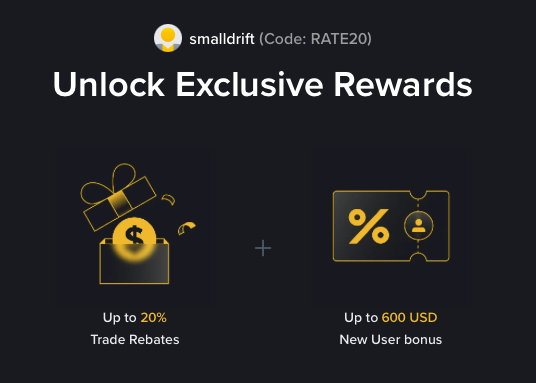
- Referral code: RATE20, pre-applied by this link
- Fee discount: 20%, shown on the Binance signup screen
- Additional rewards: Check Binance for current promotions and regional availability
Be wary of unofficial referral offers promising benefits they cannot show. The Binance signup screen lets you check the code and fee discount directly.
Compare Binance fees and available discounts →
SmallDrift may earn a commission when you sign up through this link. Trading involves risk, including loss of capital.
Related Articles


Explore Related Guides
Daily Crypto Market News
Follow Bitcoin price moves, major altcoins, and the events shaping the market.
Bitcoin ETF Flows Guide
Understand ETF inflows and outflows, and how to read them alongside price action.
Binance Fee Calculator
Learn how to estimate trading costs with referral and BNB discounts.
Verified Binance Referral Guide
See how RATE20 is applied and what to check on the Binance signup screen.