Bitcoin at $63K on Aug. 15: Fear Is Not the Signal
Bitcoin sits near $63,053 with Fear at 34. See the ETF, whale, altcoin and support levels—and Binance referral code RATE20 for a 20% discount.
Bitcoin is hovering around $63,053 while the Fear & Greed Index reads 34. That is not capitulation, but it is uncomfortable enough to make every red candle sound like a verdict. The useful question today is not whether fear is present—it is whether buyers are quietly using it.
The market is split between a live spot price that is barely green over 24 hours, a still-fragile ETF demand story, and a technical structure that has not broken its low-$60,000s base. That combination makes August 15 a decision day for the range, not a day for dramatic predictions.
This article uses a free-to-use Unsplash raster image. Market data is a live snapshot and can change after publication.
Bitcoin is calm on the surface and cautious underneath
Bitcoin is range-bound near $63,000, with a modest 24-hour gain but no confirmed breakout. CoinGecko’s live snapshot shows BTC at approximately $63,053, with a market capitalization near $1.266 trillion and 24-hour volume around $19.17 billion.
| Asset | Price | 24h change | Market cap | 24h volume |
|---|---|---|---|---|
| Bitcoin (BTC) | $63,053 | +0.23% | $1.266T | $19.17B |
| Ethereum (ETH) | $1,880.53 | +0.50% | $226.95B | $4.68B |
| BNB | $611.32 | +0.56% | $81.41B | $451.10M |
| Solana (SOL) | $75.37 | -0.17% | $43.92B | $1.04B |
| XRP | $1.005 | -0.07% | $62.98B | $998.52M |
The numbers describe a market that is stabilizing, not sprinting. ETH and BNB are slightly firmer, while SOL and XRP remain effectively flat to lower. Bitcoin’s volume is large in absolute terms, but not accompanied by the kind of expansion that would make a move through overhead supply immediately convincing.
For context, CoinDesk’s recent market coverage has described BTC trading in a broad mid-$60,000 range while macro and equity-market volatility keep traders defensive. That is consistent with today’s tape: buyers are present, but they are not yet bidding as if resistance does not exist.
Fear at 34 is information—not a trade signal
A Fear & Greed reading of 34 means sentiment is cautious, not that Bitcoin has automatically reached a bottom. The Alternative.me Fear & Greed Index currently classifies the market as Fear.
Fear can help create asymmetric setups because forced sellers and nervous spot holders become more price-sensitive. It can also persist during a genuine downtrend. Sentiment is a thermometer; it is not a navigation system.
The better question is what fear is doing to behavior:
- Are spot buyers absorbing dips near $62,000–$63,000?
- Is volume increasing on advances rather than only on selloffs?
- Are BTC and ETH holding while high-beta altcoins lag?
- Is leverage rising faster than spot demand?
Today, the answer is mixed. Price has held the area, but the altcoin tape is not confirming a broad risk-on rotation. That usually argues for patience rather than a heroic position.
Free-to-use Unsplash raster image; the sentiment interpretation is SmallDrift analysis.
The ETF bid needs a second act
ETF inflows are constructive only if they persist long enough to change the marginal buyer. Recent reporting has highlighted a sharp contrast: U.S. spot Bitcoin ETFs experienced a difficult July, while early-August sessions brought a renewed burst of buying. That is a meaningful shift in the short-term flow picture, but it is not yet proof of a durable allocation cycle.
The CoinDesk report on whale accumulation captured the unusual part of the setup: large holders reportedly accumulated more than 270,000 BTC in two weeks even as U.S. spot ETFs recorded roughly $4 billion of outflows in June. The divergence matters because it suggests the market had a buyer willing to absorb institutional selling—but it does not tell us whether that buyer will keep showing up at $65,000.
Read the flow signal in three layers:
| Signal | Current interpretation | What would strengthen it |
|---|---|---|
| ETF demand | Improving after a weak July | Two or more weeks of net inflows |
| Whale accumulation | Supportive supply-side evidence | Accumulation continues as BTC rises |
| Price response | Still trapped below resistance | Daily close above $65,000 with volume |
The market wants a handoff: ETF buyers and large wallets need to become visible in price, not just in dashboards. Until then, the bullish case is credible but incomplete.
Key Bitcoin levels for August 15
Bitcoin needs to defend $61,000 and reclaim $65,000 before the short-term structure turns decisively bullish. These are zones, not laser-guided targets.
| Zone | Why traders care | Confirmation |
|---|---|---|
| $66,000–$67,000 | Upper range supply and likely trapped sellers | Close above the zone, then a successful retest |
| $65,000 | First important reclaim level | Daily close with rising spot volume |
| $62,000–$63,000 | Current decision area | Buyers defend dips without a leverage spike |
| $60,000–$61,000 | Broad range floor | Higher low or strong spot absorption |
| $58,000–$59,000 | Breakdown-risk area | Loss of $61,000 followed by a failed retest |
Free-to-use Unsplash raster image. The levels are analytical zones, not guaranteed outcomes.
The bullish path is straightforward: hold the current area, reclaim $65,000, and turn $66,000 into support. The bearish path is also straightforward: lose $61,000, fail the retest, and expose the upper-$50,000s. Traders sometimes add complexity because a complicated forecast feels safer. Price rarely rewards the extra adjectives.
Altcoins are refusing to confirm an altseason
The major-altcoin tape does not yet show broad risk appetite. ETH and BNB are slightly outperforming BTC over 24 hours, but SOL and XRP are flat to lower. That is relative resilience, not a market-wide rotation.
| Asset | 24h read | Market message |
|---|---|---|
| ETH | +0.50% | Some relative strength, but no decisive breakout |
| BNB | +0.56% | Resilient exchange-linked beta |
| SOL | -0.17% | High-beta demand remains selective |
| XRP | -0.07% | Defensive trading near $1.00 |
For a healthier risk-on phase, Bitcoin would ideally rise while ETH/BTC stabilizes, SOL outperforms, and total market volume expands. Today’s snapshot is closer to a Bitcoin-led holding pattern. That is not bearish by itself; it simply means the market has not earned the word “altseason.”
Binance’s role in a range-bound market
Binance-specific news is increasingly about product breadth and compliance as well as listings. The exchange continues publishing jurisdiction-specific official announcements, including trading-pair changes, product updates, and regional availability notices. That matters for active traders because the same asset or feature may not be available under identical terms in every country.
The practical takeaway is unglamorous but useful: check the live product page, fee schedule, and local eligibility before acting on a headline. An announcement is not a universal invitation, and a listed token is not a risk rating.
Trade the range without donating to friction
When Bitcoin chops between support and resistance, fees matter more because traders are tempted to make several small decisions instead of one large one. That is where a referral discount can have a measurable—if limited—effect.
Sign up on Binance with 20% fee discount →
Use referral code RATE20 at signup when the offer is available to your account and region. You can also get 20% off with code RATE20 and verify the current terms before trading.
How much can a Binance referral discount save?
The Binance referral code RATE20 can reduce eligible base trading fees by 20%, subject to Binance’s current terms. The dollar value depends on volume, product, fee tier, payment method, and jurisdiction.
| Monthly trading volume | Example base fee at 0.10% | Approx. 20% saving |
|---|---|---|
| $5,000 | $5.00 | $1.00 |
| $25,000 | $25.00 | $5.00 |
| $100,000 | $100.00 | $20.00 |
| $500,000 | $500.00 | $100.00 |
These are illustrations, not a promise of a universal rate. Confirm the number displayed in your Binance account. A discount can reduce execution friction; it cannot turn a losing setup into a profitable one. The market remains stubbornly unimpressed by clever coupons.
Stack discounts carefully
Depending on the product and account tier, Binance may also offer reductions for paying fees with BNB or using maker-style limit orders. Review the live schedule before assuming every discount stacks.
- 20% off — Use referral code RATE20 at signup when eligible.
- BNB fee payment — Check the current account-level reduction.
- Maker orders — Limit orders may have a different fee from market orders.
Effective fees can be lower than the base rate, but the exact figure changes. Treat the interface as the source of truth.
Start trading on Binance with maximum discount →
Frequently asked questions
Is Bitcoin bullish or bearish on August 15, 2026?
Bitcoin is range-bound with a cautious bullish cushion, not in a confirmed breakout. Holding $61,000 keeps the base case alive; a daily close above $65,000–$66,000 would provide stronger confirmation.
What is the best Binance referral code?
The best Binance referral code is RATE20 when the 20% offer is available to your account and region. Enter it during signup and verify the displayed discount before completing registration.
How much can I save with Binance referral code RATE20?
RATE20 can save 20% of eligible trading fees, subject to current Binance terms. At a hypothetical 0.10% base rate, $100,000 in monthly volume would mean $100 in base fees and approximately $20 in referral savings before other adjustments.
Bottom line
Bitcoin near $63,053 is not signaling failure. It is asking for proof. Fear at 34 creates an atmosphere where a durable bid would matter, while ETF and whale data suggest that some buyers are willing to absorb supply. But neither signal has yet forced a break above the $65,000–$67,000 ceiling.
Watch $61,000 below and $65,000 above. A defense of the first followed by a high-volume reclaim of the second would improve the setup materially. Until then, keep leverage modest, define invalidation before entry, and let the range finish its sentence.
Create your Binance account with 20% fee discount →
Referral code: RATE20 — verify the current offer, eligibility, and fee terms during signup.
This article is for informational purposes only and does not constitute financial advice. Always do your own research before making investment decisions.
Get 20% Off Binance Trading Fees with RATE20
New to Binance? Open the official signup page with RATE20 already applied for a 20% trading-fee discount. You do not need to copy or type the code. Review the referral details before completing registration.
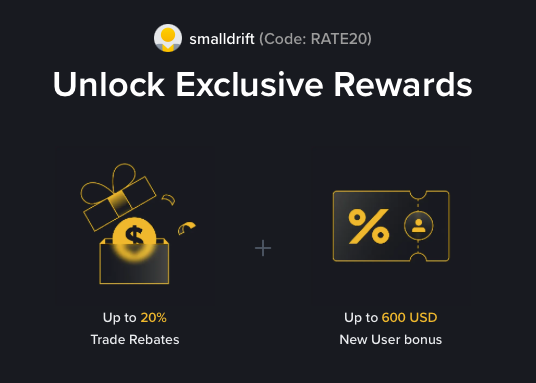
- Referral code: RATE20, pre-applied by this link
- Fee discount: 20%, shown on the Binance signup screen
- Additional rewards: Check Binance for current promotions and regional availability
Be wary of unofficial referral offers promising benefits they cannot show. The Binance signup screen lets you check the code and fee discount directly.
Compare Binance fees and available discounts →
SmallDrift may earn a commission when you sign up through this link. Trading involves risk, including loss of capital.
Related Articles
Explore Related Guides
Daily Crypto Market News
Follow Bitcoin price moves, major altcoins, and the events shaping the market.
Bitcoin ETF Flows Guide
Understand ETF inflows and outflows, and how to read them alongside price action.
Binance Fee Calculator
Learn how to estimate trading costs with referral and BNB discounts.
Verified Binance Referral Guide
See how RATE20 is applied and what to check on the Binance signup screen.